About Me

My photo
Author of three books set in Africa: Safari Jema, My Life with Ndoto, and The Dancing Bridge of Kamunjoma. I write about travel and adventure from my home in California and from Africa. I've sailed a catamaran from California to Hawaii, trekked in the Himalayas, worked as a construction manager on a bridge project in Zambia, hiked 500 miles of the Camino de Santiago, cruised 6000 miles on The Great Loop, and traveled to more than100 countries and all seven continents. Indie Book Award Winner for Best Memoir of 2012, New York Book Festival Honorable Mention for Non-Fiction, San Francisco Book Festival Honorable Mention for Non-Fiction, Travelers Tales Solas Award for Best Travel Writing Honorable Mention for My Gambian Husband. Indie Book Award Finalist - Best Travel Book 2013. BOTYA Honorable Mention 2013 - Travel Essay. 2022 Indie Book Award Finalist for Dancing Bridge. Member of The Explorers Club since 2013 Thanks for reading!
Showing posts with label Kenya. Show all posts

Thursday, July 28, 2011

Would You Want an Animal to Die for your Ornamentation?

http://www.youtube.com/watch?v=AElxLdGWF2U&feature=youtu.be

Watch this short video about ivory poaching then decide.

Sunday, August 8, 2010

Playing Scrabble With the Samburu


Kenya, from Moyale south to Marsabit, is rife with bad roads and broken down vehicles. We broke down only twice. One time the power steering went out. The other time a tire exploded leaving 200 feet of rubber guts on the one-lane corrugated and potholed track. The good thing about having a break down in Northern Kenya is that the fantastically attired, spear bearing Samburu people come out of nowhere to watch you repair your vehicle.


The Afar people of Ethiopia Samburu are even more creatively decked out. One woman had a tin pot perched on her head and another wore a clear plastic bag fastened to her ears with strings made of bark. The Samburu clad themselves in bright red or pink fabric and colorful beaded necklaces and bracelets. Most carry a cell phone. The only other thing they carry is a spear. Everything they wear somehow looks brand new. Even the multi colored pipe cleaners or plastic rose buds they add to an already elaborately decorated headdresses looks like it has never been used. They are vain but they deserve to be. They’re gorgeous.


In some ways, Marsabit reminded me of Timbuktu in Mali. The streets were covered in sand and it had an “out in the boondocks” feel to it. I loved it!


We shopped for dinner in the open air market and bought the same produce we had bought all the way from Cairo to Nairobi; carrots, onions, tomatoes, cabbage, eggplant, garlic, chilies, and sometimes bell pepper was available. A pod of children, who could barely walk, followed us through the market smiling, waving, and shouting hello about a hundred times. Samburu women dressed in vibrant fabric brightened the town when they came in to either buy or sell carrots, onions, tomatoes, and cabbage.


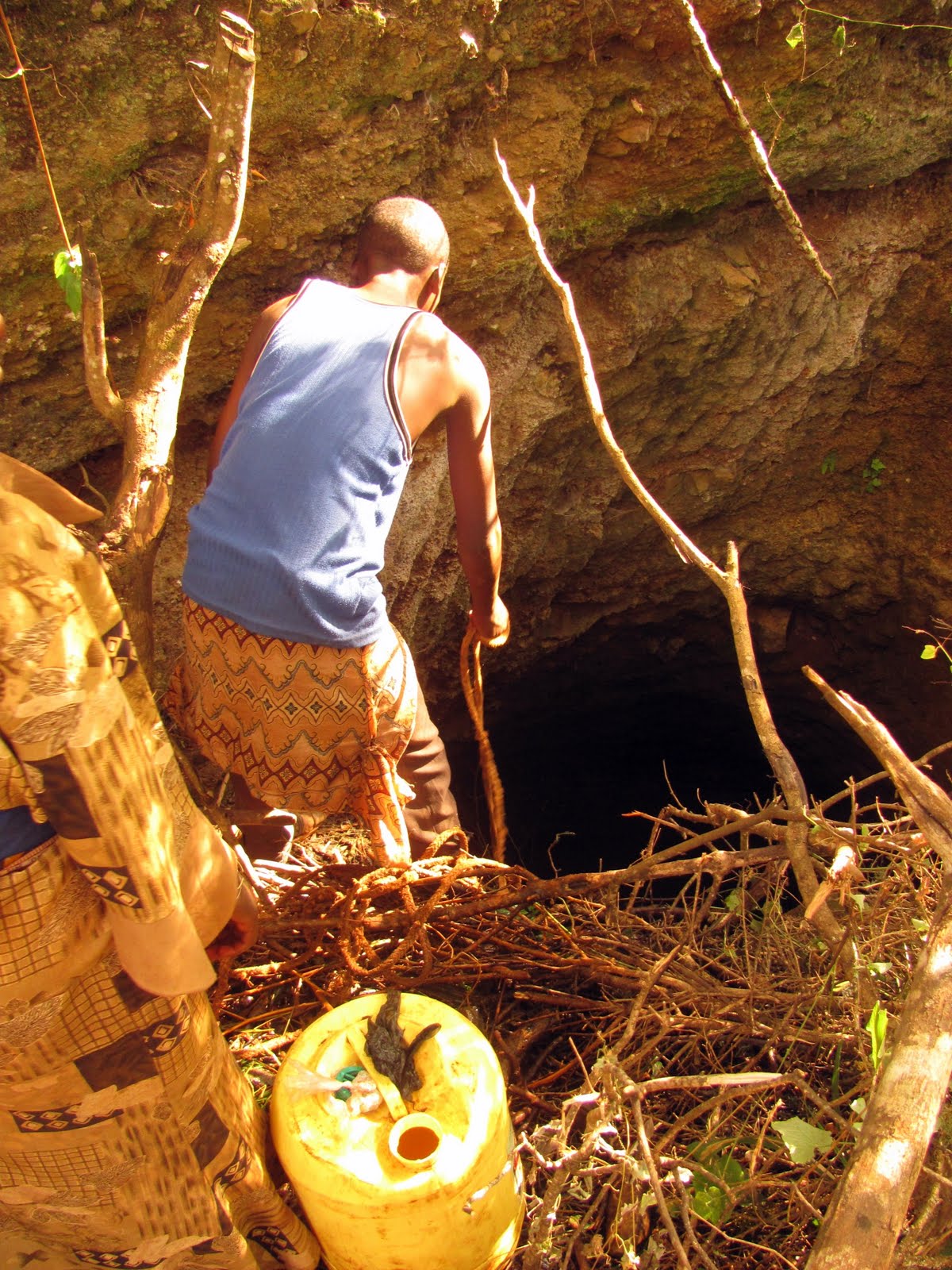
On the outskirts of town, Scott and I viewed the gravestones of African soldiers who fought in The King’s African Rifles, The East African Military Labour Service, and The African Pioneer Corps in a meticulously maintained World War II cemetery. We walked up into the hills surrounding Marsabit to visit a Catholic church run by Bantu nuns, and followed women carrying empty five gallon plastic containers to the famed “singing wells” although no one is singing much these days when they dip their buckets deep into the last remaining well.


Drought has hit Marsabit hard. For several years, they haven’t had any rain to speak of and most of the water is delivered to town by truck. Even the water holes (old volcanic craters) at Marsabit National Park have all but dried up so wildlife, except for a few elephant and baboon, are scarce. Still, Marsabit Park is hilly and beautifully dense with foliage so we all piled into three game drive vehicles and made our way into the park to enjoy nature and see what we could see. After a few hours we stopped to stretch our legs and those of our group in the pickup truck all said, “We have the worst driver! He slows down at odd times and then speeds when going uphill. He’s awful!” We found out just why his driving was so unpredictable when our vehicle came upon the empty pickup stalled out on the upslope side of the road bogged in soft dirt. Our African Trails driver Karl heard about the incompetence of the pickup driver and got behind the wheel to rescue the truck and drive it up the hill. He gunned it and the stuck tire was suddenly freed. But instead of going forward up the hill, the truck careened out of control backwards at a terrifying speed coming to rest halfway up a steep bank, t-boned into the hillside.


“There’s no brakes!” shouted Karl. “Yes, no brakes”, said the driver of the pickup with succinct simplicity. It explained why it was that he sped up hills and drove seemingly out of control downhill. “You should have told me!” yelled a shaken Karl. The all wheel drive on the truck was also kaput so Scott, Chris, and Phil had to bounce up and down on the back of the vehicle while the driver floored it to dislodge the truck from the hill. While the drivers stood around discussing how they would get everyone back to Marsabit town safely, some of us walked back to a lodge overlooking a dry waterhole to drink warm beer and wait for the handful of elephants that were rumored to show up at 4 o’clock each afternoon. It became the day known as: No brakes, no cold beer, and no elephants. But that was okay because while I knew while we probably wouldn’t be getting cold beer anytime soon, we would be seeing scads of elephants in Samburu National Park the next day.

We camped near Archer’s Post in a Samburu village located just outside the park gates. I picked out the perfect spot for our tent in a dry riverbed, which, from the fresh dung and tracks present, was on a well-used elephant trail. But the tribesmen nixed my choice saying it was too dangerous. Each night the warriors fed the campfire and kept watch over our camp to drive any wild animals away. Darn.


The Samburu invited us into their huts, let us carry their super adorable and cuddly children around camp, invited us to dance with the Samburu women, “Shake your business!” they all said.


After preparing a goat feast for us, the Samburu men taught us all about their culture. When I asked why every warrior we met had all four front teeth missing -two top, two bottom - they explained that teeth were pulled at age 14 so that if ever a warrior is unable to ingest the daily staple of blood and milk from a cow it can be poured in through the gap. It is taboo for a warrior to die with an empty stomach. We asked about cow stealing, an old Masai and Samburu tradition. They said their cows were never stolen because they have “tight security.” Tight security consists of a few warriors guarding the kraal surrounding the cows armed with spears.


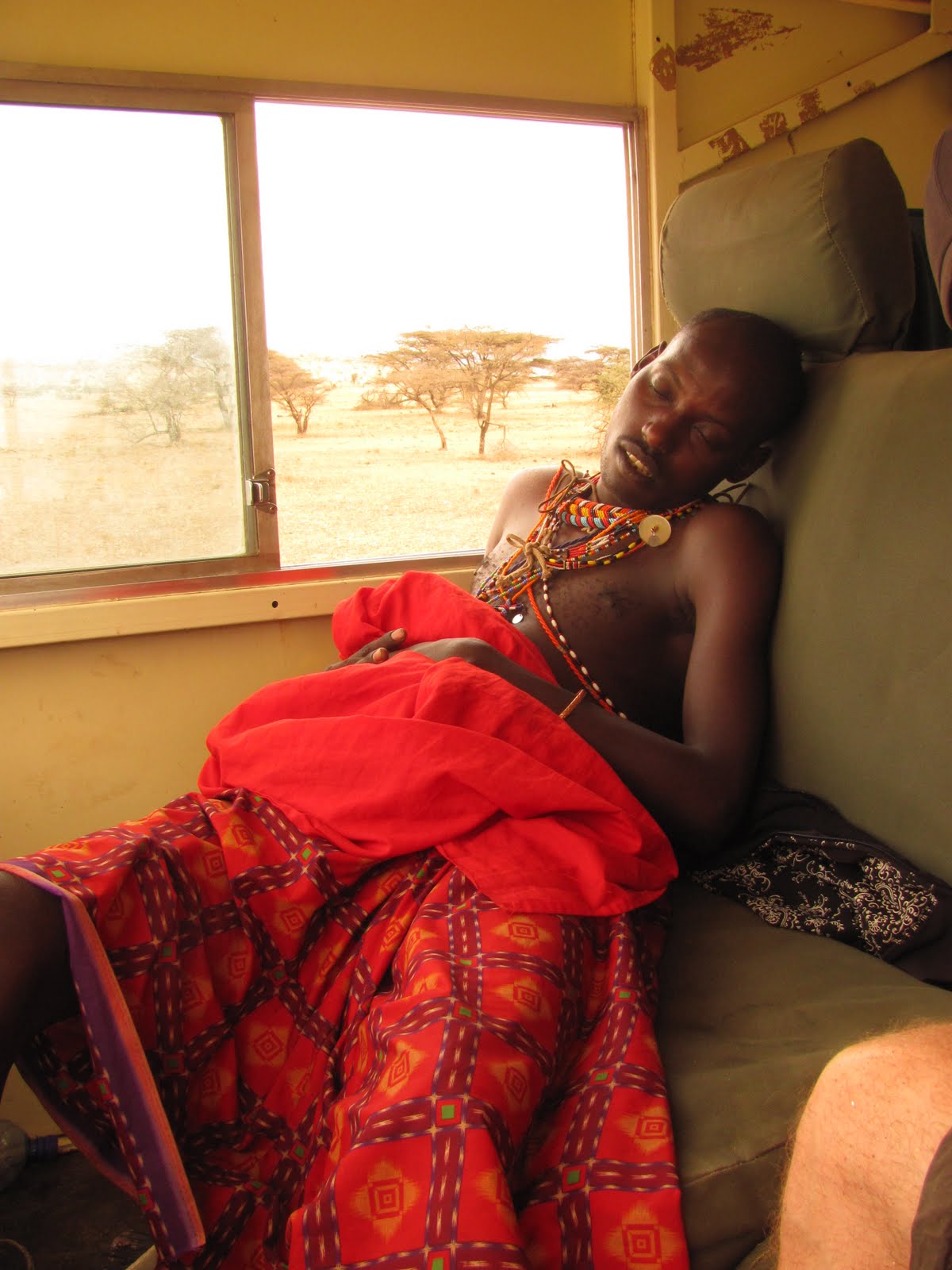
When two Samburu warriors accompanied us on a game drive the next day they seemed to know where the animals would be at any given time and could predict their behavior. Within a few hours we had already seen a pride of lions with cubs, giraffe, elephant, and impala. Before lunch we stopped near an Acacia tree that was occupied by a leopard. Within five minutes, one of the Samburu said to me, “Please tell everyone to be quiet now. The leopard is about to HUNT! Her ears are FORWARD!” He accompanied “hunt” and “forward” with the most descriptive hand gestures and facial expressions I have ever seen. He actually looked like a real leopard on the hunt. Sure enough, not 100 feet away, we watched the leopard, her ears intently forward, remain frozen in place while a male impala passed beneath her. A baby impala and the mother were not far behind. The leopard let the baby pass just seven feet below her then in one motion she leapt directly onto the mother and clenched her jaws around the impala’s throat to strangle her. It was an incredible sight. After a few minutes, exactly when the Samburu said she would, the leopard dragged her kill up into another tree. It was one of the most thrilling game drives I have been on in all of East Africa. Even the Samburu were spent after all the excitement and they both fell into a deep sleep on the way back to the village.


I marveled at how the Samburu could predict the behaviors of the animals that day but the Samburu are nothing if not observant. After watching us play scrabble for a few minutes that evening they completely took over the game, borrowing tiles from opponent’s trays when they needed a letter and making words out of turn. The Samburu are intelligent, enthusiastic, and energetic not to mention physically striking. Just when I was thinking about The White Masai a book written by a culturally ignorant and self-absorbed Swiss woman on vacation who falls for a Samburu warrior, marries him, has his baby and basically ruins his life before taking his baby back to Switzerland, the Samburu warrior sitting next to me asked, "Have you ever read The White Masai?" I have read it but I want my brother to read it. If possible would you send it to me?”
I was surprised not only that he had read it but that he would want his brother to read such a book. “What did you think of the story?” I asked. He hesitated before saying, “There are a lot of bad things in there…. If my wife took my baby away, I would just kill myself.”


We said goodbye to the Samburu people with a promise to send photos and drove to the base of Mt. Kenya where the motto at Mt. Kenya university is “Scaling The Heights of Education!” Over several days we explored the slopes if not the summit of Mt. Kenya and, since the trip would be coming to end a few days later in Nairobi, we did a thorough spring-clean of the overland truck. We hiked to the Mau-Mau caves where the anti-colonial rebels hid out until independence. I stayed outside making sandwiches because after reading The Hot Zone, I never, ever go into a cave where bats reside.


We arrived in Nairobi a few days later. Well not Nairobi but in Karen a suburb 15 kilometers away named for Karen Blixen who wrote Out of Africa. You can tour her house and coffee operation at the foot of the Ngong hills but the main reason to stay in Karen is so you can visit the Sheldrick elephant orphanage. We first went to the orphanage 5 years ago when there were only eight of us there to see the elephants. One baby orphan ran up to me, sniffed my toes, wrapped his trunk firmly around my arm, and stuck my hand in it’s mouth and used it like a pacifier. This time, there were around 150 people there and it was hard to get close to the elephants. But one still managed several times to back in amongst the hoards where we were standing because he loved to have his rear end scratched. On the way back to camp we drove around not one but two stay lefties. Stay lefties is the term given by the locals to roundabouts built by the British. The name came about because the sign on them says, “Stay Left” so that is what they called them. Just beyond the second stay lefty we stopped at another sanctuary to hand feed giraffe.


It was hard saying goodbye to Kenya with it’s quintessential African skies and all our new friends that we had traveled with for 9 weeks up the Nile from Cairo to Nairobi but we had an appointment with a village that needs us to help them build a bridge in Zambia.


See photos of Kenya at http://picasaweb.google.com/scottandtris/KenyaUpdate
Scott and Tris
Nairobi Kenya

Next: Avoiding Arrest on Drug Trafficking Charges in Zambia: We’re Not a Gang. We’re a Club!

Thursday, April 15, 2010

A Boat, Boots, Bedouins, and A Bridge - On the Camino de Santiago

A Boat:

On March 16th, 2010, I was busy loading my backpack (one pair boots, 2 pair socks, 2 pair hiking pants, 2 t-shirts, rain gear and, last but not least, ear plugs) for a 6-week trek in Spain when Scott said, “What if we travel to Spain by sea instead of by air?” By the 17th I was trying to fit cruise attire into my backpack. By the 20th, Brazilians (we boarded in Sao Paolo) were handing Scott their cameras and asking him to take their photo.
We didn’t manage to fit much cruise wear into our packs after all, so I think they mistook him for crew. (This has happened to us before). Scott played along, cheerfully arranging everyone and putting them in the best light. “Smile! Say queso!” he said, which wasn’t even right since the Portuguese don’t say, “cheese” before taking a photo. If they did it would sound more like “kejzo” anyway. But queso or kejzo, it didn’t matter. Both end in an “O", so a few Brazilians who mistook Scott for crew have photos of themselves looking like they've just been goosed.

We occupied our days at sea by finding creative ways to make hiking gear passable on “formal” nights (impossible), and by reading, playing trivia, and talking to nice people, especially those from Holland and America. Most afternoons found Scott in the library, where he learned to play Bridge from a patient teacher who just happened to be the doppelganger for my wonderful brother Mike. That was nice...

Boots:

My hiking boots disintegrated on the flight over from San Jose. I don’t know how or why. At first I took it as a sign from God. After all, what idiot would commence a 500-mile trek without training for it? Yours truly and her one true love, that’s who! Our training consisted of walking around the ship - four times around the deck was a whole mile.
After one such rotation I noticed that my boot was baring its sole all over the promenade deck - insulation was flying everywhere. Soon, the entire boot bottom was flopping around after me like a spatula stuck to my foot. I needed appropriate shoes for the hike in Spain, but our favorite outdoor store, REI, was an ocean away. But I was in luck! The island of Tenerife, off the coast of Africa, is a duty-free shoppers paradise  that specializes in electronics. They also sell footwear such as Nike, Puma and Solomon.

At the first shoe store, the saleswoman said with disbelief, “Size 9 and a half! Are you kidding me?” Then, she announced it over the P.A. system. The other customers in the store pointed at me and stared, waiting to see what would happen next. I know they were thinking, ‘Big foot! It’s not a myth!’

The shop clerk gave me a look of pity as I left, shoeless: How ever did you get this nice man to marry you with feet the size of tennis rackets? her eyes said.

After several more false starts and sniggers by wide-eyed shoppers and clerks, I was able to find a pair of Solomon hiking boots that fit perfectly. So what if I had to buy them in the men’s department? They have served me perfectly well so far.

We began the hike in Pamplona, home of the running of the bulls and occasional hangout for the late Ernest Hemingway. In Pamplona you can find signs such as, ‘Hemingway slept here’, ‘Hemingway wrote here’, ‘Hemingway drank here’, and random shops simply called 'The Hemingway'. We didn’t stay at the Hotel Hemingway near the bullring because it was 200 euros per night, but as we stood in the lobby soaking up the aura of the notorious adventurer, a hotel guest noted our hiking apparel and said, “You must be Peregrinos. You should stay at the Refugio!” He walked us there, pointing out the places where Hemingway had a cigar and took a lover.

For more than 900 years Peregrino has been the term for anyone hiking The Camino de Santiago.  Refugios, or Albergues, were where they slept.
In Pamplona, for 6 euros each, we were assigned a bunk in a 100-bed dormitory that was housed in an ancient monastery. We were numbers 92 and 93 to sign in.
Most refugios on the Camino have at least 30 beds in one room. “Sounds smelly!” you might be thinking, and you would be right. Hundreds of years ago, a monk or priest would walk through the Refugio swinging a smoking incense ball to dull the odiferous funk of the pilgrims as they slept. Modern day Refugios have hot showers, laundry machines, Internet, and kitchens. Still, that first night in Pamplona, I thought a few passes with an incense ball wouldn’t hurt. Two hundred sweaty boots smell like a wet cow. No worse than that - like a wet cow with bad breath that snores with its mouth open.


It’s not that bad. I brought lots of earplugs with me, the refugios are spotless, and a slight smear of Vicks under the nose works wonders. If it weren’t for all the Germans who get up at 5 a.m. to use up all the hot water and race to the next Refugio for the best bunk (the German half of me really wants to do that too), the refugio experience would be great.
So far, all the refugios are co-ed. Even the dorms and the bathrooms aren’t divided by sex. It’s like living in a house with a hundred brothers and sisters from all over the world. We’ve met Estonisan, Dutch, German, Irish, English, Canadian, and lots of Spanish peregrinos. On rare occasions we get a double room to ourselves, and that is muy bien. So far, we haven’t met any other Americans but we probably will meet one or two over the next 40+ days of the hike.

One is supposed to be on a spiritual or cultural quest to hike The Camino. If we see it as a spiritual quest, and make it to Santiago, where the bones of St. James rest in peace, we will be awarded an indulgence. An actual indulgence! That means if I complete the Way of St. James, as the Camino is called, I will earn an indulgence and all my sins will be instantaneously wiped clean. Poof! Permanent record erased. Then, if I were to get hit by a car or something before I have a chance to sin again, I would go straight to Heaven. The chances that I wouldn't sin again shortly after leaving the compostela office by, say, taking the Lord's name in vain,"Gosh darn! That is one beautiful Cathedral!" (only it wouldn't be "gosh"), or coveting chocolate or beer or woman's boots is pretty remote. The "express to Heaven" reward was more significant before the Pope did away with purgatory anyway. But still, I will be walking a little lighter after I gain the indulgence, at least for a few moments.
Strange to say if you know me, but I do feel spiritual while walking the Camino. At least that's how I interpret the vibe. I feel just so darn happy all the time. I have long thought nature is my religion and I feel closest to my Maker when I am out in it.
Scott says his intention is a cultural quest, which I don’t mind one bit, because he has been giving me history lessons everyday. Whether it be details about an old Roman road we are walking on, or tidbits regarding Spanish or Portuguese explorers, it is always interesting and takes my mind off my aches and pains.

“Keep an open mind,” I suggested. “After 6 weeks on the trail, you might find it has somehow become a spiritual quest.” To which he replied wincing, “Very likely since my feet might die and go to heaven before I get there.”
I hope that doesn’t happen. But this is only day 4 of our hike, and he is already walking like Amos McCoy. I resemble Grandma Moses - in mens boots. I don't think I needed to clarify that. I think Grandma Moses always wore mens boots, didn't she?

Every day, we trod up and down hills, through vineyards, olive groves, and newly planted wheat fields so green the wheat looks like a jade river swirling down hills and around the vineyards. We walk from village to village, over narrow, or muddy, or rocky footpaths just the way pilgrims did 900 years ago - except we are powered more by café con leche and chocolate croissants, than by gruel. The villages are so charming, and the churches along the way so magnificent, that they distract us from thinking about our sore feet or backs, or calves, or thighs, or knees, or shoulders-- at least for a little while. We walk about 12-15 miles per day, which takes us 6 to 8 hours depending on the terrain. But our packs are way too heavy because we have stuff in them that we don’t need in Spain, but which we do need for Africa, which leads me to Bedouins.

Bedouins:

Mid-May will find us in Cairo, where we will join an overland truck for a ten week journey up the Nile that will take us through Egypt, Sudan, Ethiopia and Kenya.

In August, we will transit to Zambia to help build a bridge.

Bridge: A footbridge, that is, in Zambia. We will work with a non-profit called Bridges to Prosperity. Learn more about how we became connected with this organization at: www.firstgiving.com/teresaokane

We’ll be gone Five months, Bridge (San Francisco) to bridge.

We love hearing from you!
Hasta Luego! Scott and Tris

Torres del Rio, where Hemingway, as far as I know, didn’t sleep.
The Way of St James,
Spain

Haiku (sort of) for the day:
Behind the hay
I peed
The hills were green