BOOTS, BEDOUINS, AND A BRIDGE. This journey begins with a hike on The Camino de Santiago in Spain then takes you through Africa from Cairo to Zambia. You'll find tips on hiking The Camino, adventure travel, and working with a non-profit in Africa. BOOTS: Hiking 500 miles on The Way of St. James in men's boots. BEDOUINS: Overland from Cairo to Nairobi through Egypt, Sudan, Ethiopia, and Kenya. A BRIDGE: Building a footbridge in rural Zambia. Please contact author for re-use rights.
About Me
- Teresa O'Kane
- Author of three books set in Africa: Safari Jema, My Life with Ndoto, and The Dancing Bridge of Kamunjoma. I write about travel and adventure from my home in California and from Africa. I've sailed a catamaran from California to Hawaii, trekked in the Himalayas, worked as a construction manager on a bridge project in Zambia, hiked 500 miles of the Camino de Santiago, cruised 6000 miles on The Great Loop, and traveled to more than100 countries and all seven continents. Indie Book Award Winner for Best Memoir of 2012, New York Book Festival Honorable Mention for Non-Fiction, San Francisco Book Festival Honorable Mention for Non-Fiction, Travelers Tales Solas Award for Best Travel Writing Honorable Mention for My Gambian Husband. Indie Book Award Finalist - Best Travel Book 2013. BOTYA Honorable Mention 2013 - Travel Essay. 2022 Indie Book Award Finalist for Dancing Bridge. Member of The Explorers Club since 2013 Thanks for reading!
Monday, August 16, 2010
Time Travel on the Lake Tanganyika Ferry
It seemed like a good plan. Take a 12-hour bus ride from Nairobi in Kenya to Dar es Salaam in Tanzania, and then ride a train for three days to Kigoma on the shore of Lake Tanganyika where we would catch the twice-monthly ferry to Zambia.
The first part of the plan worked like a charm. The bus ride was long (15 hours instead of 12), bumpy, and dusty but we arrived in Dar in one piece - always something to celebrate when traveling by public transport in the developing world. The next morning found us at the train station to book a sleeper only to find that the train would not be running any time soon due to a very specific reason, “many problems.” We had to be in Kigoma by the 27th to catch the ferry so we were suddenly scrambling to find another way to get there on time. Days and days on buses on horrible roads driven by sleep deprived men intent on passing on blind curves at unsafe speeds would be our least favorite option. Luckily, Air Tanzania, the only airline flying to Kigoma, had two seats left on the only flight with availability that week. We had a few days to kill in Dar but that was fine by us because Dar es Salaam is one of our favorite African cities. Even though it’s big, it manages to retain a friendly vibe. We even felt comfortable walking around at night.
The best part about Dar (besides Sunday Brunch at the Movenpick Hotel) was that we ran into Jo and Will whom we last saw two years ago in Cape Town. Scott was on his way to the Angola embassy to inquire about visas in case we had time to travel there before our trip ended. For whatever reason he decided to stop in at the City Supermarket shopping center on the way.
Walking through the arcade he heard, “Scott!” It was Jo, the awesome, bubbly, enthusiastic photographer who ran the photo safari we did two years ago and Will the driver was with her. “What a small world!” we said later to Will after hugs all around. (Weeks later in the garden of a small hotel in Petauke, Zambia we would meet and share a few beers with a Peace Corps volunteer who had taught my nephew Colin at Mitty High School in San Jose. “What a small world!” we all said. I love it when we connect with friends –Anne Marie, Alex, Maria, Conner…– at the oddest times in the oddest places- and it happens more often than I ever thought it would.)
The flight to Kigoma was wonderful. We had seats 1 and 2 on a 20-seat propeller plane - and a small plane is the only way to fly in Africa. You can make out people in the bomas below and sometimes, even spot animals. And, just like in the good old days, some kids on board got to meet the captain and co pilot in the cockpit during flight. We landed on a gravel runway and waited for our luggage in a baggage claim area that consisted of one bench and a plywood shelf. One by one, baggage was placed on the shelf while an airline worker called out the person’s name on the baggage claim.
After collecting our backpacks we walked outside to find a taxi so we could get to the ferry office in time to pay for our cabin and find a place to stay for the night. But, for the first time ever in all our travels, there were no taxis and no touts clamoring for our business. We contemplated walking to town when a well-dressed man, the manager of the Lake Tanganyika Lodge, walked up to us and asked if we needed help. Sam was picking up an American couple on tour and, after we explained that we needed to get to the ferry office as soon as possible, made us an offer we couldn’t refuse. “Allow me to drive you to my hotel via the ferry office. If you like my hotel, please stay. If not, you will have a free ride into town.” He nodded towards the couple waiting in the hotel van. “On the way, we will stop at the place where Stanley met Livingston on the shore of Lake Tanganyika.” That was fine by us!
The spot where Stanley first encountered Livingston is marked with a plaque under a mango tree, though the lake has receded considerably from the spot where first they made contact. Global warming, I presume? There is also a small museum with photos and drawings depicting Livingston’s life in Africa. We sat in the shade under the mango tree while a young man told us the story of Livingston; how he came to Africa to explore, fight slavery, bring Christianity, how he died in Africa and how it took his two faithful servants over a year to carry his body back to England.
It was an interesting lecture but it was being told almost in real time, and we were very anxious to get to town to secure our cabin on the ferry. Since the ferry operates only twice a month we either had to secure passage on the ferry leaving the next day or we would be forced to face four grueling days on trucks and bush taxis to get where we needed to be in Zambia.
Scott stood up and with a big smile said, “Livingston, what a guy!” putting a period on the lecture and heading to the mini van.
When we arrived at the ferry office, we were told that they had given away our cabin. After much discussion, they decided to put us in the family cabin, which is the only cabin on board with it’s own toilet, so that was fine by us! Then Sam said that if we stayed at his hotel he would not only grant us a late check out, he would transport us back to the ferry the next afternoon in time for the scheduled 3pm departure. He drove us to his hotel, which was just a short distance from where the MV Liemba was docked and the Lake Tanganyika Lodge hotel was beautiful so that was fine by us. We changed into swimsuits, ordered beers, and dove into the sparkling clean pool fronting the lake. The American couple, it turned out, was on their first trip to Africa and on their honeymoon. We toasted both their decisions and watched the sun go down over the lake together.
The MV Liemba is the world’s oldest continuously operating passenger ferry ship in the world and, Lake Tanganyika, bordered by Tanzania, The Congo, Burundi, and Zambia, is the longest lake in the world. Those two facts alone were enough to make us want to make the 3-day, 2-night trip south to the shores of Zambia. But the Liemba has an interesting and complicated history making it all the more enticing. It was built in Germany in 1912 and, in parts, was brought to Africa to be used as a cargo ship. During WWII it was enlisted into service as a German military expedition ship against the Belgians in the Congo, and the British in Northern Rhodesia (Zambia). The Belgians sunk it. Later the Germans raised it, took it to Kigoma and, after greasing the engine, deliberately sunk it again. (The story of the MV Liemba was the inspiration for the movie The African Queen where Humphrey Bogart and Katherine Hepburn sink the German cargo ship.) After the war, the British raised it and began using it as a cargo and passenger ferry, and that is still what it is being used for today. The captain, crew, and many of the passengers appreciate the age of the ship and treat her with the respect she deserves.
But, really, a hundred-year-old ship? It couldn’t have been that great. It was! In 1970, the Danes provided a grant to refurbish it, the engine was changed from coal to diesel and the rotted out berths and benches were replaced. But the best part of being on the Lake Tanganyika ferry was the feeling of traveling back in time.
All along the shores of Lake Tanganyika are villages so remote there isn’t a single road leading to them. Just as it was hundreds of years ago, the lake is their lifeline to the outside world. We discovered this firsthand at 10 pm the first night when incredible shouting coupled with a slowing of the engine woke us. Outside our cabin we looked into the darkness to see ten leaky wooden boats powered by Yamaha outboards and a few dug out canoes (powered by oar) jam-packed with humanity and cargo all clamoring to get on board at once. At the same time from third class two decks below, an equivalent number of people and cargo were trying to get off the ferry and onto the little boats. Bananas, pineapples, sacks of cotton and rice, and mattresses, a lot of mattresses, were being thrown either up onto the ferry cargo deck or down into the wooden boats. Those who carried only a suitcase or sack frantically climbed up the sides of the ferry to our deck and made their way quickly downstairs before the crew could catch them. That sight and the fact that there was so much screaming had me worried at first that we were being hijacked (boat jacked?). You know how much I like pirates but this was a little unsettling. “Holy Crap!” I said to Scott as we watched organized chaos in action. It was like that for about half an hour. Then the wooden boats and dug out canoes laden with new passengers and cargo headed for shore and all was instantly quiet on the ship. Mothers on the cargo deck went back to breast-feeding their babies, passengers who had cabins retired to their bunks and everyone else (most of the 500 on board) found a little space between pineapples and bananas and 5-gallon jerry cans of palm oil on deck to sleep.
This same scenario was repeated every two or four hours over the three-day passage whenever we neared a village. If we were asleep, we got up to watch the spectacle. If it was during the day we walked around the top deck taking photos. It gave new meaning to the term ‘on board entertainment’. Most of the shouting came from the wooden transport boats as they approached the ferry at ramming speed. They get paid not only per passenger but also per piece of cargo so they raced to get alongside the ferry to be first because he who gets there first and shouts the loudest gets the most. We watched quite a tug of war between two boatmen over 3 plastic chairs. Unbelievably, bobbing amongst the transport boats were women in smaller boats calmly selling fish and fried bread to passengers on the ferry, even in the middle of the night. We didn’t get much sleep those two nights on the Liemba due to all the commotion but it was a window into the past. The people who live along Lake Tanganyika rely on the twice monthly visits of the cargo ferry ship for food and for transport just the way they have for a hundred years.
There were a handful of other western travelers on board most, as we were, in first class cabins. The beer was cold and the food in the dining lounge was good. Yes, there were cockroaches and probably a rat or two but there was plenty of interesting conversation. If you are meeting a westerner for the first time on the Lake Tanganyika ferry chances are they are well traveled and have a story to tell and our fellow passengers did not disappoint. A Dutch doctor had just finished his internship at a clinic in a small village in Tanzania. He was visibly shaken by what he had seen in the village, especially the deaths and suffering and amputations that could have avoided with proper medical care. He said the most upsetting thing was that people waited too long to see a doctor, choosing first to use the witch doctor or use herbs that often made things worse. What most upset him was watching the labor of girls too physically young to even be having children suffer horribly because of herbs they had taken to make the baby come faster. He could barely talk about his experience. He even had to leave the village a little earlier than planned, “I just had to get out of there”, he said emphatically.
Then there was the uber enthusiastic German geography teacher who had to pay a $50 fine for taking photos of the harbor in Kigoma and told us the story of the time he was nearly arrested for the photos he took in Cuba. But his students are sure learning a lot! An English couple in Africa for a year, and a well-traveled French-Chinese couple rounded out the table nicely. They all got off in Tanzania, one stop before we did to see the second highest waterfall in Africa, a four-hour hike in and out. We wished we could have fit it in to our itinerary. “Next time”, Scott said. We watched them disembark and leave the dock on the only transport around. In the back of a huge lumbering lorry they were packed like sardines with, again, pineapples, bananas, and mattresses but also bicycles and sacks and sacks of something. Suddenly we were the only two mzungus (white foreigners) left on the ferry, which is why my next update is titled, Avoiding Arrest on Drug Trafficking Charges at the Zambian Border.
Petauke, Zambia
Sunday, August 8, 2010
Playing Scrabble With the Samburu
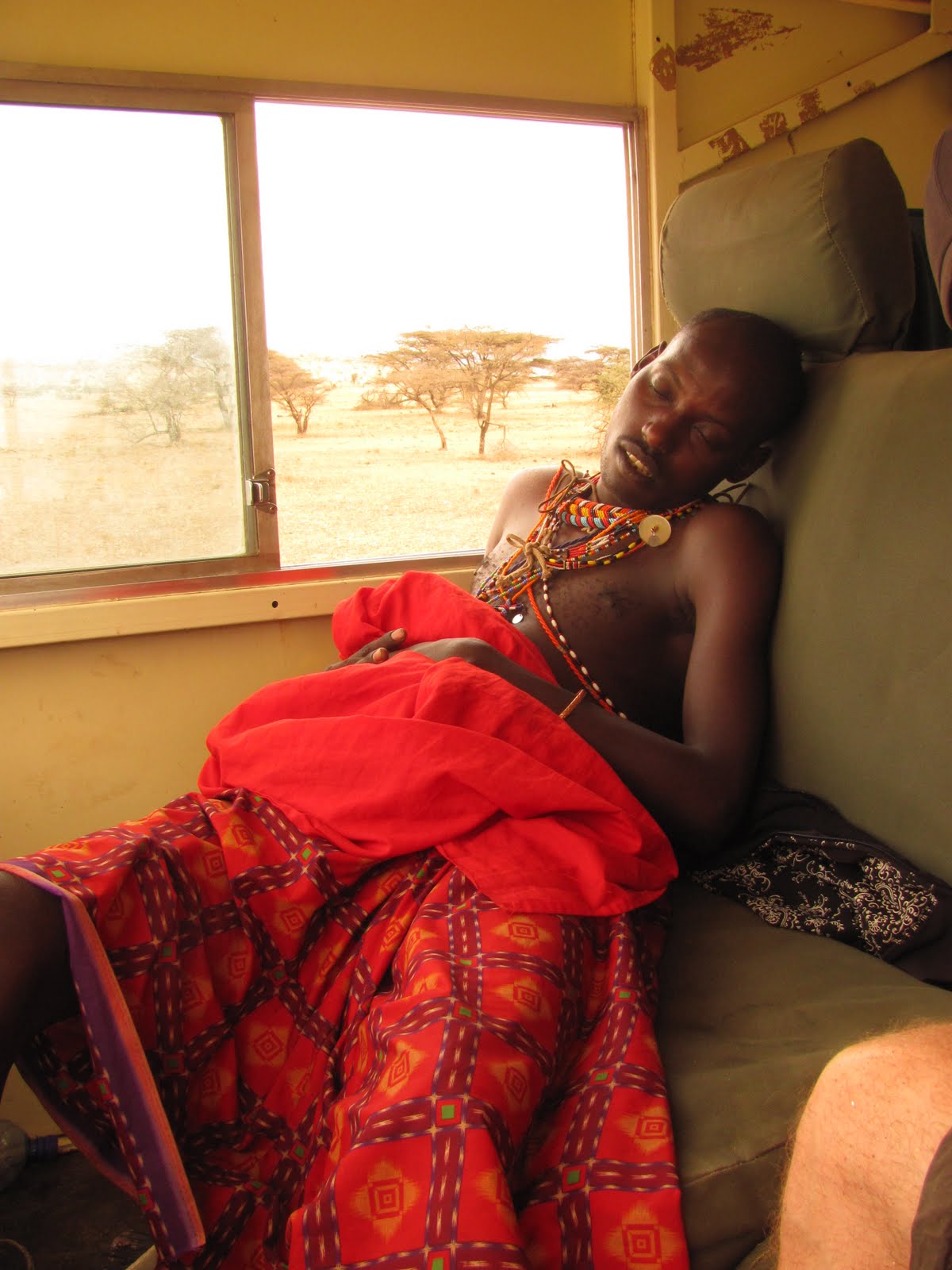
Kenya, from Moyale south to Marsabit, is rife with bad roads and broken down vehicles. We broke down only twice. One time the power steering went out. The other time a tire exploded leaving 200 feet of rubber guts on the one-lane corrugated and potholed track. The good thing about having a break down in Northern Kenya is that the fantastically attired, spear bearing Samburu people come out of nowhere to watch you repair your vehicle.
The Afar people of Ethiopia Samburu are even more creatively decked out. One woman had a tin pot perched on her head and another wore a clear plastic bag fastened to her ears with strings made of bark. The Samburu clad themselves in bright red or pink fabric and colorful beaded necklaces and bracelets. Most carry a cell phone. The only other thing they carry is a spear. Everything they wear somehow looks brand new. Even the multi colored pipe cleaners or plastic rose buds they add to an already elaborately decorated headdresses looks like it has never been used. They are vain but they deserve to be. They’re gorgeous.
In some ways, Marsabit reminded me of Timbuktu in Mali. The streets were covered in sand and it had an “out in the boondocks” feel to it. I loved it!
We shopped for dinner in the open air market and bought the same produce we had bought all the way from Cairo to Nairobi; carrots, onions, tomatoes, cabbage, eggplant, garlic, chilies, and sometimes bell pepper was available. A pod of children, who could barely walk, followed us through the market smiling, waving, and shouting hello about a hundred times. Samburu women dressed in vibrant fabric brightened the town when they came in to either buy or sell carrots, onions, tomatoes, and cabbage.
On the outskirts of town, Scott and I viewed the gravestones of African soldiers who fought in The King’s African Rifles, The East African Military Labour Service, and The African Pioneer Corps in a meticulously maintained World War II cemetery. We walked up into the hills surrounding Marsabit to visit a Catholic church run by Bantu nuns, and followed women carrying empty five gallon plastic containers to the famed “singing wells” although no one is singing much these days when they dip their buckets deep into the last remaining well.
Drought has hit Marsabit hard. For several years, they haven’t had any rain to speak of and most of the water is delivered to town by truck. Even the water holes (old volcanic craters) at Marsabit National Park have all but dried up so wildlife, except for a few elephant and baboon, are scarce. Still, Marsabit Park is hilly and beautifully dense with foliage so we all piled into three game drive vehicles and made our way into the park to enjoy nature and see what we could see. After a few hours we stopped to stretch our legs and those of our group in the pickup truck all said, “We have the worst driver! He slows down at odd times and then speeds when going uphill. He’s awful!” We found out just why his driving was so unpredictable when our vehicle came upon the empty pickup stalled out on the upslope side of the road bogged in soft dirt. Our African Trails driver Karl heard about the incompetence of the pickup driver and got behind the wheel to rescue the truck and drive it up the hill. He gunned it and the stuck tire was suddenly freed. But instead of going forward up the hill, the truck careened out of control backwards at a terrifying speed coming to rest halfway up a steep bank, t-boned into the hillside.
“There’s no brakes!” shouted Karl. “Yes, no brakes”, said the driver of the pickup with succinct simplicity. It explained why it was that he sped up hills and drove seemingly out of control downhill. “You should have told me!” yelled a shaken Karl. The all wheel drive on the truck was also kaput so Scott, Chris, and Phil had to bounce up and down on the back of the vehicle while the driver floored it to dislodge the truck from the hill. While the drivers stood around discussing how they would get everyone back to Marsabit town safely, some of us walked back to a lodge overlooking a dry waterhole to drink warm beer and wait for the handful of elephants that were rumored to show up at 4 o’clock each afternoon. It became the day known as: No brakes, no cold beer, and no elephants. But that was okay because while I knew while we probably wouldn’t be getting cold beer anytime soon, we would be seeing scads of elephants in Samburu National Park the next day.
We camped near Archer’s Post in a Samburu village located just outside the park gates. I picked out the perfect spot for our tent in a dry riverbed, which, from the fresh dung and tracks present, was on a well-used elephant trail. But the tribesmen nixed my choice saying it was too dangerous. Each night the warriors fed the campfire and kept watch over our camp to drive any wild animals away. Darn.
The Samburu invited us into their huts, let us carry their super adorable and cuddly children around camp, invited us to dance with the Samburu women, “Shake your business!” they all said.
After preparing a goat feast for us, the Samburu men taught us all about their culture. When I asked why every warrior we met had all four front teeth missing -two top, two bottom - they explained that teeth were pulled at age 14 so that if ever a warrior is unable to ingest the daily staple of blood and milk from a cow it can be poured in through the gap. It is taboo for a warrior to die with an empty stomach. We asked about cow stealing, an old Masai and Samburu tradition. They said their cows were never stolen because they have “tight security.” Tight security consists of a few warriors guarding the kraal surrounding the cows armed with spears.
When two Samburu warriors accompanied us on a game drive the next day they seemed to know where the animals would be at any given time and could predict their behavior. Within a few hours we had already seen a pride of lions with cubs, giraffe, elephant, and impala. Before lunch we stopped near an Acacia tree that was occupied by a leopard. Within five minutes, one of the Samburu said to me, “Please tell everyone to be quiet now. The leopard is about to HUNT! Her ears are FORWARD!” He accompanied “hunt” and “forward” with the most descriptive hand gestures and facial expressions I have ever seen. He actually looked like a real leopard on the hunt. Sure enough, not 100 feet away, we watched the leopard, her ears intently forward, remain frozen in place while a male impala passed beneath her. A baby impala and the mother were not far behind. The leopard let the baby pass just seven feet below her then in one motion she leapt directly onto the mother and clenched her jaws around the impala’s throat to strangle her. It was an incredible sight. After a few minutes, exactly when the Samburu said she would, the leopard dragged her kill up into another tree. It was one of the most thrilling game drives I have been on in all of East Africa. Even the Samburu were spent after all the excitement and they both fell into a deep sleep on the way back to the village.
I marveled at how the Samburu could predict the behaviors of the animals that day but the Samburu are nothing if not observant. After watching us play scrabble for a few minutes that evening they completely took over the game, borrowing tiles from opponent’s trays when they needed a letter and making words out of turn. The Samburu are intelligent, enthusiastic, and energetic not to mention physically striking. Just when I was thinking about The White Masai a book written by a culturally ignorant and self-absorbed Swiss woman on vacation who falls for a Samburu warrior, marries him, has his baby and basically ruins his life before taking his baby back to Switzerland, the Samburu warrior sitting next to me asked, "Have you ever read The White Masai?" I have read it but I want my brother to read it. If possible would you send it to me?”
I was surprised not only that he had read it but that he would want his brother to read such a book. “What did you think of the story?” I asked. He hesitated before saying, “There are a lot of bad things in there…. If my wife took my baby away, I would just kill myself.”
We said goodbye to the Samburu people with a promise to send photos and drove to the base of Mt. Kenya where the motto at Mt. Kenya university is “Scaling The Heights of Education!” Over several days we explored the slopes if not the summit of Mt. Kenya and, since the trip would be coming to end a few days later in Nairobi, we did a thorough spring-clean of the overland truck. We hiked to the Mau-Mau caves where the anti-colonial rebels hid out until independence. I stayed outside making sandwiches because after reading The Hot Zone, I never, ever go into a cave where bats reside.
We arrived in Nairobi a few days later. Well not Nairobi but in Karen a suburb 15 kilometers away named for Karen Blixen who wrote Out of Africa. You can tour her house and coffee operation at the foot of the Ngong hills but the main reason to stay in Karen is so you can visit the Sheldrick elephant orphanage. We first went to the orphanage 5 years ago when there were only eight of us there to see the elephants. One baby orphan ran up to me, sniffed my toes, wrapped his trunk firmly around my arm, and stuck my hand in it’s mouth and used it like a pacifier. This time, there were around 150 people there and it was hard to get close to the elephants. But one still managed several times to back in amongst the hoards where we were standing because he loved to have his rear end scratched. On the way back to camp we drove around not one but two stay lefties. Stay lefties is the term given by the locals to roundabouts built by the British. The name came about because the sign on them says, “Stay Left” so that is what they called them. Just beyond the second stay lefty we stopped at another sanctuary to hand feed giraffe.
It was hard saying goodbye to Kenya with it’s quintessential African skies and all our new friends that we had traveled with for 9 weeks up the Nile from Cairo to Nairobi but we had an appointment with a village that needs us to help them build a bridge in Zambia.
See photos of Kenya at http://picasaweb.google.com/scottandtris/KenyaUpdate
Scott and Tris
Nairobi Kenya
Next: Avoiding Arrest on Drug Trafficking Charges in Zambia: We’re Not a Gang. We’re a Club!
Saturday, July 31, 2010
You! I Love You!
The next day I discovered we weren't the only Americans
traveling in Ethiopia when I heard, “This orange juice is freaking ridiculous! It's awesome!” coming from a nearby table on the terrace of our hotel near the main roundabout in Gondar.
I looked over at the two twenty somethings from Colorado as they chugged the orange juice.
. The juice in their glasses was awesome. It was pure, fresh
squeezed, and thick. It’s the way juice comes here in Ethiopia.
You can get
mixed juice in layers too if you want. One layer of orange, another of avocado,
a third of mango… It’s freaking ridiculously healthy and delicious and awesome and only
costs around twenty cents for a mug.
Coffee, which was invented in Ethiopia, is
not bad either. They call it a “ceremony” when they grind, brew, and pour it in
front of you. I wasn’t always sure about the flavor though. At a Starbuck’s like cafe, called Kaldi’s Coffee Shop, we were able to order a frapoocino.
Ethiopia is mostly made up of mountains and people. If you could view all of Ethiopia from the air, you would
see some paved, but mostly dirt roads crisscrossing the mountainous country and
very few vehicles.
A road in Ethiopia is one long conveyer belt moving an
endless stream of pedestrians from village to village and city to city. From
sun up to sun down it seems all of Ethiopia is out for a walk. Herders drive
sheep, goats, camels, cattle and loaded donkeys down the middle of the road.
Women walk miles and miles with huge bundles of wood or plastic jugs of water
on their heads and babies on their backs. Men carry 14-foot long sections of
timber for scaffold.
And everyone seems to carry an umbrella or a stick with
them where ever they go. When children spotted our truck and Farange (white foreigner) faces they
practically trembled with excitement. They jumped up and down and spun in
circles. As our driver leaned on the horn and weaved around the unperturbed
masses they cried out, “You! Farange! Where do you go?” or,
“You! I love you!” or often just, “You, you, you, you!” When we stopped to bush
camp for the night, it wasn’t long before there was a group of children
gathered around us. At one stop I inflated one of the plastic globes I brought
with me and showed the children where we all were from - England, Australia,
Ireland, New Zealand, Canada, and the U.S.
They were absolutely fascinated
while I held it during the geography lesson. We all pointed at spots on the globe and ooed and aahed. But when I handed them the globe and
suggested, “Take this to school, to your teacher” they did what all children do
when they get something bouncy and round. They played soccer with it. Within a
few minutes, it was punctured and they were back at my side asking me to repair
it. I would always say the same thing, “The world is fragile. You
can’t kick it around.” All I got in return were blank stares and, “You! Fix
it!”
“Al Gore has been trying to do that for years” I’d say, and
they would give me a look that said, “This white lady is crazy…. but she has
footballs” and smile broadly while holding the globe out to me.
In Lalibela we camped near The Obama Souvenir Shop.
(Later in Tanzania Scott stopped in to get his hair cut at the Shave and Be
Smart Barber Shop that had a painting of Obama and some unknown (by me)
rapper on the sign.) For the most part, they like President Obama here in East
Africa and for the first time in our travels we get a lot of thumbs up and
comments such as, “American has the democracy we only dream of.”
Lalibela is famous for it’s 13th century
underground rock hewn churches but we’ve seen them before on a previous trip so this time we
headed for the huge open market located at the edge of town. We were hard
pressed to find any produce.
The market consisted primarily of live goats,
camels, donkeys, chilies, and exotic spices for sale. Our sole purchases were a
very hot Berber spice powder, and an umbrella. Such a handy thing the Ethiopian
umbrella. I used it for sunshade, for an instant privacy screen for emergency
loo stops along the road (after ingesting too much Berber spice), and a few
times I even used it in the rain.
In Gondar we toured the Dashen Brewery and tasted beer in the garden for far
too many hours. But it was the first beer we had been able to get since Egypt-
Islamic Sudan is not only arid, it’s “dry” and we were mighty thirsty. The next day there was a pounding in my
head. But it wasn’t from the beer. From the hotel terrace I watched a man with a hammer pounding large
stones into small ones. All day long he
sat on a pile of the gravel and patiently shattered rocks.
While Scott hiked the Simian Mountains for three days, I
nursed my bulging Achilles tendon in Gondar. From the hotel terrace I
watched countless donkeys carrying recycled US AID sacks on their backs as they walked
themselves through the bustling streets unaccompanied by a human. Donkey after donkey walked with odd purpose through downtown Gondar. They were obviously on a mission. But
where were they all going? How did they know which way to go? After a day of
watching and wondering I decided to follow one of the donkeys. I walked behind a
donkey with a load of hay for about an hour before finally asking two women, “Where do the
donkeys go?” Rather I pantomimed it since they didn’t speak English and my
Amharic is limited to hello, goodbye, beer, and thank you. The women pointed far up a
mountain side. Sure enough I could just make out a train of donkeys headed up into the hills. It looked like a steep hike and that wouldn’t have done my tendon any
good, so I never did discover the ultimate destination of the donkeys. Still, I
would recommend the donkey walk to anyone visiting Gondar.
In Bahar Dar Scott saw the headwaters of the Blue Nile
during a spectacular downpour while I had a close encounter with an escaped
crazed monkey in the campground.
In Harar, children held our hands while we walked around
inside the old city walls. At night we fed raw meat to wild hyenas from the end
of a stick that we held between our teeth.
Well, I did. Scott had no desire to
get within ten feet of the steel jawed carnivores that regularly roam the
alleyways of Harar. (If the video actually uploads, you can see me feeding them by clicking on the photo link
below.)
In Addis Ababa I spent a day at the Hilton enjoying their
sauna, steam, and Jacuzzi with a few of the girls from the truck and considered
booking a massage after I saw a billboard for a day spa where one kitty is
giving a massage to another. Puuurrr.
In Awassa I visited the fish market and tried to keep the
blue-ballied monkeys (I can’t remember what they are really called but
blue-ballied is the more descriptive name for them anyway- see photos!) away
from our picnic lunch on the bank of beautiful Lake Awassa.
Everywhere in Ethiopia we watched World Cup Football
usually in a bar packed with locals who were politely supportive when either
the US, Australia, or England were playing, just because they guessed that’s where
we were from.
Lastly, in Ethiopia, for the first time ever in all our
travels to Africa, when we lifted our cameras to take photos of locals, they were
often already taking photos of us with their cell phones.
In a few days, when they’ve finish loading (I’m not kidding.
Internet connections are just that slow) you will be able to check out photos
of the crazed monkey and all the Ethiopia photos at: http://picasaweb.google.com/scottandtris/EthiopiaUpdate
Next: Playing Scrabble With the Samburu Tribe in Kenya
Kwaheri! (Bye in Swahili)
Scott and Tris,
Kigoma
.
Thursday, July 15, 2010
Swimming The Nile in a Muu-Muu
In the sandy port town of Wadi Halfa we waited two days for our truck to catch up to us. It was supposed to leave before us in a separate vehicle ferry but the ferry had broken down and was towed to Sudan by a tug. While we waited we climbed every hill in the area (two), pet stray puppies, took tuk-tuk rides, drank cardamom-flavored coffee and ate chicken and rice with pita.
It was a time of killing time and casting about for random activities. Not only were all our clothes on the truck but also most of our books, our journals,and our money. One late afternoon English Alice and I waved down a tuk-tuk, showed him ten Sudanese Pounds, and asked him to “just drive us around, ten pounds worth.”
When he dropped us off back in town he made the crazy person sign to his friend by circling his index finger around his temple.
At dusk, we climbed up a small mount to watch the last of the setting sun and at night we slept on webbed beds in a dirt courtyard practicing patience while counting shooting stars.
In a small covered market I bought a muu-muu. For my British friends, in this context it’s a long Hawaiian dress, not a female body part. When I wore it around town local men gave me thumbs up and exclaimed “ Good! Good!” and women gave me a smile and a look that said, “Hello, sister.” Days later when we drove off the main road to Khartoum to find a waterhole where we could get some relief from the heat, I walked directly into the Nile, muu-muu and all. The heat drove me to it but in hindsight it was a stupid thing to do because over the doorway of a hut near the river was a crocodile head, and across from it lying on the ground was a complete 14-foot long croc carcass. Scott thought it’s gaping mouth, teeth intact, made for a good photo op – “Tris, put your head inside!” We asked the man leading us to the river, “Did you kill those crocodiles?”
“Yes, I shot them right here,” he said, gesturing to the area where we were supposed to swim. But that’s just how hot I was, and I walked right in. Sadly, the Nile was only wet, not refreshing. It too was reaching the boiling point.
Somewhere between Wadi Halfa and Khartoum - the hot days have all blended together in one hazy mirage - we visited the Nubian Pyramids of Meroe. Nubians were building pyramids long before the Egyptians even started. I prefer the slender lines of the Nubian variety to those at Giza, despite the fact there isn't a Pizza Hut restaurant within a thousand miles. The Nubian ones are still out in the middle of the desert where pyramids should be. Accompanied by two Bedouins who walked along next to me I rode a camel around the Pyramids holding my red umbrella over me for shade. Scott said I evoked an image of Lawrence of Arabia.
When we reached hot, dusty Khartoum we thought we would get some respite from the heat since we would be camped along the Nile at the Blue Nile Sailing Club, but it was still 110 degrees in the shade.
In teams of four we take turns cooking for our group of twenty overlanders and the first night in Khartoum my tean was on K-P. We decided on Sudanese style Spaghetti Bolognese. We were stunned by the price of tomatoes - $15 for 4 kilos - and we eyed with trepidation the beef hanging in the open-air, bloody floored meat shop. “Well, let's just cook it a really long time,” I said as the butcher lopped off a 2-kilo hunk of red meat of an unidentifiable animal and put it through a mincer. Thanks to the culinary skills of Phil (one-half of the delightful Tom and Phil twins on board) and Matt who reminds me of my nephew Colin and makes me long for home at times, it turned out great. I made garlic bread by spreading olive oil on pita bread and covering it with dried spices and small chunks of garlic. That came out pretty good too. It was a hot and dusty afternoon spent shopping for food then cooking over a charcoal fire. By the time the dishes were done and everything was put away I was dying for a shower. But there was no water! There are times when a wet one, even one the size of a bath towel just doesn't suffice and this one one of them. I went to bed that night sticky and miserable.
The best thing, the only thing, you can say for the Blue Nile Sailing Club is that The Melik, the gun boat that Lord Kitchener took up the Nile to conquer the Mahdi, sits as a monument in the middle of the hot and dusty campground. thinking it might somehow be a little cooler inside the old boat I climbed some rickety stairs to take a self guided tour and found a couple of men using it as their bachelor pad. there was no relief from the heat at all. Fortunately later that day Kamal Omar, a longtime member of the Blue Nile Sailing Club, took a few of us out for a sunset cruise on the Nile in his motorboat. Finally respite from the heat! Hot dogging water skiers from Dubai deliberately doused our boat as they jetted by. The waters of the Nile cooled me, and my muu-muu - you Brits can infer your meaning of muu-muu now - enough to be able to sleep that night.
Scott and Tris (in her muu muu),
Khartoum
Next: Ethiopia. “You! I love you!”
It was a time of killing time and casting about for random activities. Not only were all our clothes on the truck but also most of our books, our journals,and our money. One late afternoon English Alice and I waved down a tuk-tuk, showed him ten Sudanese Pounds, and asked him to “just drive us around, ten pounds worth.”
When he dropped us off back in town he made the crazy person sign to his friend by circling his index finger around his temple.
At dusk, we climbed up a small mount to watch the last of the setting sun and at night we slept on webbed beds in a dirt courtyard practicing patience while counting shooting stars.
In a small covered market I bought a muu-muu. For my British friends, in this context it’s a long Hawaiian dress, not a female body part. When I wore it around town local men gave me thumbs up and exclaimed “ Good! Good!” and women gave me a smile and a look that said, “Hello, sister.” Days later when we drove off the main road to Khartoum to find a waterhole where we could get some relief from the heat, I walked directly into the Nile, muu-muu and all. The heat drove me to it but in hindsight it was a stupid thing to do because over the doorway of a hut near the river was a crocodile head, and across from it lying on the ground was a complete 14-foot long croc carcass. Scott thought it’s gaping mouth, teeth intact, made for a good photo op – “Tris, put your head inside!” We asked the man leading us to the river, “Did you kill those crocodiles?”
“Yes, I shot them right here,” he said, gesturing to the area where we were supposed to swim. But that’s just how hot I was, and I walked right in. Sadly, the Nile was only wet, not refreshing. It too was reaching the boiling point.
Somewhere between Wadi Halfa and Khartoum - the hot days have all blended together in one hazy mirage - we visited the Nubian Pyramids of Meroe. Nubians were building pyramids long before the Egyptians even started. I prefer the slender lines of the Nubian variety to those at Giza, despite the fact there isn't a Pizza Hut restaurant within a thousand miles. The Nubian ones are still out in the middle of the desert where pyramids should be. Accompanied by two Bedouins who walked along next to me I rode a camel around the Pyramids holding my red umbrella over me for shade. Scott said I evoked an image of Lawrence of Arabia.
When we reached hot, dusty Khartoum we thought we would get some respite from the heat since we would be camped along the Nile at the Blue Nile Sailing Club, but it was still 110 degrees in the shade.
In teams of four we take turns cooking for our group of twenty overlanders and the first night in Khartoum my tean was on K-P. We decided on Sudanese style Spaghetti Bolognese. We were stunned by the price of tomatoes - $15 for 4 kilos - and we eyed with trepidation the beef hanging in the open-air, bloody floored meat shop. “Well, let's just cook it a really long time,” I said as the butcher lopped off a 2-kilo hunk of red meat of an unidentifiable animal and put it through a mincer. Thanks to the culinary skills of Phil (one-half of the delightful Tom and Phil twins on board) and Matt who reminds me of my nephew Colin and makes me long for home at times, it turned out great. I made garlic bread by spreading olive oil on pita bread and covering it with dried spices and small chunks of garlic. That came out pretty good too. It was a hot and dusty afternoon spent shopping for food then cooking over a charcoal fire. By the time the dishes were done and everything was put away I was dying for a shower. But there was no water! There are times when a wet one, even one the size of a bath towel just doesn't suffice and this one one of them. I went to bed that night sticky and miserable.
The best thing, the only thing, you can say for the Blue Nile Sailing Club is that The Melik, the gun boat that Lord Kitchener took up the Nile to conquer the Mahdi, sits as a monument in the middle of the hot and dusty campground. thinking it might somehow be a little cooler inside the old boat I climbed some rickety stairs to take a self guided tour and found a couple of men using it as their bachelor pad. there was no relief from the heat at all. Fortunately later that day Kamal Omar, a longtime member of the Blue Nile Sailing Club, took a few of us out for a sunset cruise on the Nile in his motorboat. Finally respite from the heat! Hot dogging water skiers from Dubai deliberately doused our boat as they jetted by. The waters of the Nile cooled me, and my muu-muu - you Brits can infer your meaning of muu-muu now - enough to be able to sleep that night.
Scott and Tris (in her muu muu),
Khartoum
Next: Ethiopia. “You! I love you!”
Subscribe to:
Posts (Atom)