About Me

My photo
Author of three books set in Africa: Safari Jema, My Life with Ndoto, and The Dancing Bridge of Kamunjoma. I write about travel and adventure from my home in California and from Africa. I've sailed a catamaran from California to Hawaii, trekked in the Himalayas, worked as a construction manager on a bridge project in Zambia, hiked 500 miles of the Camino de Santiago, cruised 6000 miles on The Great Loop, and traveled to more than100 countries and all seven continents. Indie Book Award Winner for Best Memoir of 2012, New York Book Festival Honorable Mention for Non-Fiction, San Francisco Book Festival Honorable Mention for Non-Fiction, Travelers Tales Solas Award for Best Travel Writing Honorable Mention for My Gambian Husband. Indie Book Award Finalist - Best Travel Book 2013. BOTYA Honorable Mention 2013 - Travel Essay. 2022 Indie Book Award Finalist for Dancing Bridge. Member of The Explorers Club since 2013 Thanks for reading!

Monday, June 14, 2010

Clean! Very Clean!


Santiago to Brussels to the Gulf of Aqaba on the Red Sea. Isn’t that how everyone gets to Egypt from Spain? If you are like Scott and get giddy over cheap airfare, you do.


We didn’t have the national delicacy during our 2-day layover in Belgium - French fries doused in mayonnaise - but we did see the movie Robin Hood at a theater where we paid $40 for 2 tickets and a bag of sweet popcorn. Oh, and a euro to use the toilet. BBC News reported that Brits were giving the movie a unanimous thumbs down because Russell Crowe’s accent sounded “too Irish” and “not Nottingham-ish t’all”, but we thought he sounded merry enough and we thoroughly enjoyed the movie. The toilet however, was not worth the euro.


Finally in Africa

We met the overland truck that will transport us along the Nile for 9 weeks in Dahab, Egypt.

Dahab is where travelers on a budget and Europeans on package holidays come to dive the crystal clear waters of the Red Sea. What’s special about diving in Egypt compared to diving, say, the Great Barrier Reef? Well for one thing, when you come up for air on the Red Sea there are usually camels and Bedouins staring back at you from shore. The other thing that makes it so special is that it is an absolutely incredible diving experience. At a place called the Blue Hole where obsessed people wearing nothing but a monfin,a large mermaid’s tail on their feet and facemasks ignore the aquarium around them and try to set records for how deep they can free dive without dying, we saw fish, coral, and clams of all sizes in every color of the rainbow within 12 feet of the surface. Scott saw an octopus on the hunt and I saw a lone seahorse with a flaccid tail. The memorial dedicated to people who die every year while trying to get to the bottom of the abyss that is the Blue Hole is located at the take out point. Might it not be more useful at the entry point? On shore near a herd of camels a persistent Bedouin man wrapped and re-wrapped my head in a scarf in an effort to make me look good in it. After each time he would stand back and regard me with a dissatisfied frown while shaking his head and sighing. The only time he seemed moderately satisfied was when he wrapped the scarf in such a way that it covered everything but my eyes. He wanted 20 Egyptian Pounds for it, $4, which I almost paid until a little girl selling bracelets made from colored string walked up and whispered, “Don’t pay more than 10.”


The seafront in Dahab is lined with restaurants decorated to evoke dining in a Bedouin tent. The sandy floors are covered with a mosaic of bright carpets and huge pillows to lounge on. It’s the only spot in Dahab where you can get a wisp of a offshore breeze so it’s THE place to be between dives. With your drink or smoothie comes mezze (tahini, baba ganoush, hummus) served with freshly baked, puffy pita bread, enough to call lunch or dinner.


One block off the waterfront we found all the shops and services a holiday seeker would desire including what we needed most, a tailor and a barber. On an alleyway next to our guesthouse, a tailor replaced a zipper on our money belt and repaired a hole in an immodest location on Scott’s shorts for only $3. The barber was located on a nearby street near the sea. Akmed seemed to be doing such a good job on Scott’s hair that I asked if there was anyone around to cut mine too and a barber named Mohammed suddenly appeared by my side. It just so happens that Muslim men have given my the two best haircuts in my life; one in Pakistan, the other in Sydney, Australia so I felt pretty confident that Mohammed of Dahab would do a fine job as well. After offering me tea (“Yes, please”) and a cigarette (“No thanks”) he trimmed my hair practically strand by strand. After 20 minutes I said, “I like it. Shukran, thank you,” and started to get up.

“Not finished!” said Mohammed raising the headrest and reclining the chair in one rapid movement. He reached for a jar of powder and spool of thread.

“What? Wait. What is that? What are you doing?” I asked.

“Bebe!” he answered. “Bebe very good!” He smiled broadly and exclaimed, “You will be clean, very clean!” Quicker than I could say, “What the heck is bebe?” my eyebrows received the first “threading” of their lives. Next to me, Scott was getting threaded too! Akmed worked his threads near Scott’s side burns, in and around his ears, up his nose, and on his eyebrows too. “Ouch! Ouch!” a stunned Scott said wincing each time a hair was plucked. I still don’t understand how threading works exactly. It looks so complicated. The thread seems to begin in the barber’s mouth. Two (or four??) strands of string meet at an individual eyebrow hair then with a quick tug of the barber’s head, hairs are plucked out one after another.


Stepping back Mohammed observed my eyebrows with the same scowl of dissatisfaction as the Bedouin head wrapper and resumed shaping the old fashioned way- with scissors. He worked on them for what I thought was longer than necessary, until I said, “I think that’s enough. You don’t want to make them too perfect you know! Yuk yuk.” He muttered something in Arabic, which by the look on his face translated, “That would take a magician.” Then he put down the scissors and started to dab circles of powder at the places on my face I refer to as my Ingrid Bergman areas. Ingrid Bergman was famous for looking radiant in photos. Photographers loved shooting her because her skin appeared absolutely flawless on film. Several years ago I read a biography that revealed that the secret to Ingrid’s luminosity. A substantial amount of downy peach fuzz covered her face. Apparently the hair caught and held any natural or artificial light around her and made her glow. Ever since I read that I have embraced the Ingrid Bergman areas on my own face. Still, no close ups, please. Anyway, Mohammed never heard of Ingrid Bergman and seemed to see no benefit at all to peach fuzz.

“Whoa!” I said, “What are you doing?” I put my hand up to stop the powder puff in mid air.

“It’s ok. It’s ok. I’m going to make you clean! Very clean!” said Mohammed reaching for the thread.

“Oh no, please don’t do that.”

“Why not?” Mohammed asked with puzzlement. I remember my mother’s warning when I was twelve and wanted to start shaving my legs, “Once you start that business you can never quit.”

I looked at Mohammed and said, “If I let you do bebe then you’ll have to move in with me and do this bebe thing on me for the rest of my life. No thank you! No bebe for me.”

Then Akmed got in on the act. He stopped fussing over Scott and leaned over me studying my face as if it was under a magnifying glass. He stood back and said seriously, “Why you don’t want bebe? It will make you very clean! All women, all men in Egypt get bebe.” He leaned towards me again and ran his hand over my face from chin to forehead just as a sculptor with a piece of rough marble would.

He was beginning to rub my fur the wrong way but I believed what he said about people in Egypt regularly getting bebe. I flashed on the day we arrived when I saw someone in the airport with the most substantial mustache I’ve ever seen on a woman. She must have been away from her bebe groomer for longer than she expected. I repeated more emphatically looking from Mohammed to Akmed, “No. I definitely do not want bebe.”

“Inshallah,” Mohammed mumbled, saying a short prayer to Allah with obvious frustration. He reluctantly put the powder and thread aside, returned the chair to its full and upright position and began wetting my hair with water from a spray bottle. When it was evenly damp he opened a wide mouth jar of something labeled “Mink Conditioner.” But the subtitle intrigued me more, “With Garlic!” It said in excited bold lettering. Mohammed took a liberal scoop of it with his hand and began spreading it slowly through my hair.

“What’s that?” I asked.

“It’s ok. Not bebe. Ok. Ok.” He could tell I was getting nervous. He parted my hair down the middle and combed it slick to my head. He parted my bangs in the middle too and curled the ends ever so slightly inward so that they pointed towards the bridge of my nose. When I looked in the mirror I saw Alfalfa from the Our Gang series staring back at me. Scott took one glance at me and said to Akmed in a slightly panicky voice, “That’s enough. I think you can stop cutting my hair now.” He’d already had a head, neck, and shoulder massage, threading, shearing on the bottom half of his head and Akmed had been snipping away at the top of his head with scissors for some time. Unfortunately Scott should have asked Akmed to stop 10 minutes earlier or just let him finish the job. The style Scott has going now can best be described as a cross between a jarhead and a groomed poodle. He looks like he is wearing a too small furry blond scull cap atop his head.

As we walked back to our guesthouse I looked at Scott and said, “Well, Fifi, at least you look clean… Very clean!”

Scott looked into the Bedouin restaurant we were passing. “Is it too early for dinner? The aroma from the garlic in your hair is making me hungry.”
Scott and Tris
On the Red Sea, Egypt

Wednesday, May 12, 2010

It’s a Chafing Thing - On the Camino de Santiago

I had to add men’s Lycra boxer shorts to my hiking ensemble. It’s a chafing thing.

Every day, we take anywhere between 29,000 and 36,000 steps, and that creates a whole lot of friction on the inner thighs. I walked like Tex Ritter around town, looking for something longer than bikini bottoms, but shorter than pantaloons, to wear under my hiking pants. But in Spain, where if a woman can’t wear a thong, she wears nothing.  I had to resort to buying men’s underwear.
The saleswoman in the men’s department at the sporting goods store wrapped my purchase in a brown paper bag, wrote down the name of some "anti-friction crème", and pointed to a pharmacy nearby.
After determining exactly where the chafing was occurring  (“Aqui?” the pharmacist asked, indicating halfway between the knee and the…not the knee. “Or Aqui?” she whispered indicating not the knee), I pointed to a spot nearer the knee, only higher, and explained through pantomime and Spanglish, that hiking the Camino all day, every day was causing the damage. “Ah!” she exclaimed with sudden empathy. Then she started doing the Salsa with incredible vigor in the middle of the pharmacy. Apparently, she had the exact same problem, but not from hiking. “Bailando!” she shouted. “Dancing!”

The men’s boots (read previous post), and the men’s underwear worked a charm. After walking 720 kilometers since leaving Pamplona on Easter Sunday, we arrived yesterday at the goal line, Santiago de Compostela and the Cathedral crypt that supposedly holds the relics of the Apostle St. James. My one desire, besides making two piles for the Laundromat in Santiago - one for the wash, one for the incinerator - was that the sun would be shining when we arrived at the Cathedral. I got my wish - on the weather at least. After a week of hiking in dreary rain, and one day in heavy fog and snow, the sun shone brightly.

Unlike in other cities along the Camino, once a pilgrim enters the city limits of Santiago there is no stopping for café con leche, a beer, or to empty boots of pebbles that have settled uncomfortably between toes. There was a strong drive to just get there. Few stop for a break on the way to the the goal.
I loaded my backpack from a top bunk one last time, and crossed one last roman bridge. We were on our way. I felt melancholy that it would soon be over.
The final kilometer to the Cathedral is perfect. It winds up and down and around, keeping the Cathedral spires hidden from view until you are practically standing below them.

Serendipity was with us. After 19 kilometers, we took a wrong turn and ended up at a little used entrance to the Cathedral. No backpacks are allowed so I said to Scott, “Why don’t you go in first while I watch the bags.” After a few moments he hurried back out saying, “Tris, you have to see this!”
I walked in to see the Botafumeiro, the huge incense burner passing (flying!) just over the heads of the congregation through the entire transept. Whoosh!
The Botafumeiro hangs from ropes and an elaborate pulley system near the ceiling, 150 feet above. The sound it made, as the burner passed just feet from me, was incredible. Historically the Botafumeiro was used in the olden days, to exterminate the funk produced by all the heavily clothed pilgrims--some of whom had taken a year or more to walk from all over Europe to see the remains of St James. But seeing the incense burner in action, and feeling it as it flew overhead, moved me to tears.

I left the Cathedral and sat on Scott’s lap, crying. Maybe it was dehydration. Maybe it was exhaustion from hiking every day for the last 38 days. But I was moved by the spectacle of it all. Scott was so sweet. He said, “Since you were raised Catholic, I knew you had to see that.” I hadn’t been to Mass in years, but he was right. There was just something about it that made me feel "home".

“Shall we go get our Compostelas? You’ve earned an indulgence, you know,” Scott said.
If you hike the Camino in a Holy Year the Church rewards pilgrims an indulgence meaning, in the eyes of the Church, all sins are forgiven. I would be leaving Santiago with a “clean slate” so to speak.

“Are you kidding? I’m not going to turn that down! Let's go!” I said and we made our way to The Pilgrim Office nearby.

At the Office, one of ten officials checked our credentials, our pilgrim passports with the many stamps we received along the way proving we had walked The Way of St. James, and issued us Compostela certificates. Our certificates are different, because Scott went for the "Cultural Compostela".
“How was your journey?” asked the Church official as she filled in my name, in Latin. “It was really great." I replied wiping my tears. I could not stop crying! "And we arrived at the Cathedral in time to see the Botafumeiro fly.”

“You were very lucky!” she said. “The Botafumeiro only makes an appearance during special Feast Days, or if a group has made a large donation.”

I walked out feeling like one lucky pilgrim. Then to top it all, as we walked away from the Cathedral, a jazz musician sitting in the square began to play Somewhere Over the Rainbow, the song played at my mom’s funeral. Mom has been gone more tha two years, but she was with me almost every day on the Camino. It was a perfect end to a perfect journey.

Scott and Tris
Celebrating with champagne, Ruffles and chocolate, (as usual).
Santiago, Spain

Monday, May 3, 2010

Blessings on the Camino de Santiago


The Camino, with it's many trails that crisscross Europe and feed into the "Camino Frances" to Santiago, is designated a World Heritage site. If that isn't enough to make you want to go, 2010 is considered a "Holy Year" for Santiago. Spain is expecting over 140,000 pilgrims this year from all over the world. All who hike seem to have a  unique story of why they are walking.


A woman I met from Argentina, wants a more intimate relationship with God. Another, from America, sees it as a challenge of endurance. Linda from Canada is doing it, “For my sins and for the sins of the world.” Another woman, from Italy, said she is trying very hard to feel the spiritual aspect of the Camino but was disappointed to have felt nothing yet. In the meantime, she is enjoying meeting other twenty-something Europeans. Cyclist Jo from London, said she is doing it to be “bikini fit!” A Finnish woman is doing it because of job burn-out back home. A South African woman is hiking the Camino as a way of mourning her ex-husband who had recently passed away unexpectedly. "We've been divorced for more than ten years, but I didn't feel finished," she said. "Since beginning the Camino, I've had dreams about my ex every night and I'm finally getting closure." Edward from Germany returned to the Camino for a second time because, “The day I arrived in Santiago 4 years ago was the happiest day of my life.” A Slovenian woman gave the ever-reliable explanation, “To find myself!”


Scott and I are walking the Camino because, like the Annapurna Circuit in Nepal, or the John Muir Trail in California, it is one of the great long distance hikes in the world. Truth be told, I am also doing it for the chance to worship the outdoors, and to pet the puppies, donkeys, baby cows, and kittens we meet along the way. The Camino de Santiago is another journey long enough in distance and time, to completely immerse ourselves in a different culture. That alone makes it a worthy enough pursuit for us. But, as corny as it sounds, two weeks into the hike I realized that, for me, it is also a walk of gratitude. It seems I wake up everyday feeling grateful - for Scott, for my family, and for good friends. Also, I think about my parents almost everyday. Someone once said that the greatest gift one can give another person is a happy childhood and I'm really grateful for mine. Mom and Dad are with me everyday.

While it may not be for entirely “spiritual” reasons that we are hiking the Way of  St. James (though, if feeling grateful is not somehow spiritual, I don’t know what is), we do receive many blessings, inspirations, and surprises every day from the stories of the people we meet.

People such as Ju Yun from Korea who said at dinner one night, “I want to be a pediatrician. I have twelve years of schooling ahead of me to achieve this. But the most important thing to me is that I  have a good marriage and family.” Then he got this huge smile on his face. “When I think of what a good relationship my parents have, it gives me goose skin!” A Frenchman at the table asked, “Do you have a girl in mind?” Ju Yun threw out his arms and said, “Of course! I am a twenty year old boy. I always have girls on my mind!”

One day, while we walked a long rather monotonous section of the trail, which paralleled the main road, we came upon a man trimming his cherry trees. He called out, “Buen Camino!” and indicated we could help ourselves to candy out of a wicker basket that sat on the hood of his vehicle. His name was Pepe. He put his personal stamp in our Camino Passport and began proclaiming with enthusiasm and glee what the Camino meant to him.
I tried to talk to him in Spanish, but it came out, “Our Spanish is not well. Please speak not fast." Through charades and Spanish For Idiots, he explained that he had walked the Camino thirty years prior. “'By the time I arrived in that village” he pointed to a nearby village that could be seen through the trees, “I was so ill, I had to stay there a few days before continuing." Then, he got a great big smile on his face. "I never left the village. The young woman who had nursed me back to health became my wife.”

In a refugio, a pilgrim hostal, in Villamayor we met Miriam whose Camino walk to Santiago ten years earlier meant so much to her, she volunteers at refugios several times a year, for a week or two at a time.
In Villamayor, there is no grocery store. Only one place in town serves meals, the bar. But the bar was closed temporarily, because the owner had died. It was Miriam who cooked dinner for ten of us, then cooked another entire meal when 4 cyclists came in after 9pm. Then she made breakfast for us all the next morning.
It was only our fifth night on the trail. I pestered Miriam with practical questions about the walk; "How many kilometers per day is average", "Where is the best refugio in Burgos" and, “Does it rain as much as they say it does in Galicia?”
“Oh yes!” she answered to the last question. “But it is perfect! The rain mixes with the tears on your checks at the moment you see the cathedral in Santiago for the first time.”

Another day, we walked alone for several hours over a steep pass, which leveled out to a high forest. Coming along the trail in the opposite direction was a man pushing one of those covered carriers that parents put their kids in to tow behind their bikes. Only he wasn't pushing a child. His carrier contained a sleeping bag, food, and clothes. On the front, there was a sign that read, California to Jerusalem. As we passed one another I said, “Jerusalem? That’s a long way from The Camino!”  We quickly learned that he was starved for conversation. If you walk the Camino in reverse direction as he was doing, it’s hard to make friends, because you never meet the same people twice. As we stood shifting our weight from one swollen foot to another (walking is hard, but standing still is worse), he told us his life story. He ended by telling us that three years ago he walked the Camino for the first time and met a German woman who became his wife. (New relationships happen more often than you would think on the Camino.) Since their marriage, they have walked across America together, and it was on his 60th birthday that they set out on their longest walk yet - from California to Jerusalem. His wife was taking a break from the pilgrimage to visit family in Germany.
“What will you do once you get to Jerusalem? What do you hope to find?” we asked. “I don’t know. I guess I’ll find out when I get there."

We continued to meet people with unique motivations for the Camino. A Dutch man broke his stride long enough to say, “I am walking 1000 kilometers to Santiago. I picked my starting point in France because from that town to Santiago is exactly 1000 kilometers!”
 There is an old custom on the Camino. If you are hiking in a group, the person who catches the first glimpse of the Cathedral in Santiago earns the title "The Pilgrim King." When we asked the Dutchman if he heard of the tradition he said, "Of course! That's why I walk alone!" and he shook our hands and carried on his way.

A man from Brazil stated as he breezed by us, “Five is my magic number. I have five University degrees, five post graduate degrees, this is the fifth time I have walked the Camino and I am turning fifty this year.” He looked profoundly sad and lonely as he walked on alone.

A German woman we had seen periodically on the trail, ended up in the same refugio as us one night. We sat outside on a bench in the sun while she told us her story. She had been an engineer in the automotive industry but had begun hearing voices after a fall off a horse. She would go into work and say to her colleagues, “I know that you've been talking about me. I know what you have been saying.” She lost her job and went to a psychic who told her, “You are not crazy. You are gifted,” and that her calling was not to be an engineer, but a healer. At this point Scott interrupted with, “I think the hospitaliar might need help preparing dinner,” and disappeared into the kitchen. The engineer, I mean healer, rolled and lit another cigarette and said with a chuckle, “You would think the first thing I would do to heal myself would be to quit smoking.”

“Well, maybe the second thing,” I suggested gently. “You might want to talk to someone else about those voices you are hearing. You know, get a second opinion.”

“No, I’m definitely a healer. I healed my ankles already!”

“Did I just hear the dinner bell?” I asked.

In a village where we encountered cows coming home from the fields, we ran with them ala running of the bulls.  A ninety-year-old man approached us carrying a branch from a small bush that looked like the female reproductive system. While we spoke (he in Spanish, and me in English), he periodically whacked me with the stick for no good reason. Then with a twinkle in his eye he announced he was heading for a meal at a house of a "good woman" nearby. Did I mention that Spring has sprung here in Spain?

We are definitely meeting unique people on the Camino. Scott says many seem to be looking for an audience, "There's so much interesting history to discuss, yet they seem to go on and on about themselves!"  True, there is more than a little narcissism here on the Camino. It reminds me of something a wise Irish priest once said in a heavy brogue, “A little self-reflection can be a good ting but taking yourself too seriously, now dat’s a sin.”


There are remarkable and beautiful - inside and out - people we meet while walking the Camino. Like Pia, the Finnish nurse who fixed up my horribly blistered toe once and for all. And Miriam the volunteer hospitaliar in Villamayor who helped us better understand the spirit of the Camino. Or Randi and Henning from Denmark who are newlyweds in their 50’s and living life to the fullest, he as a fisherman, and she as an artist. Or the three retired Canadian ladies who I lent my "Mrs. Murphy" umbrella to, and want to hug every time I see them. Or young Tia, whose face is like a ray of sunshine every second of every day. Or the volunteers at the refugios who double as housemothers and treat us like their own family. Or David who, with his cart full of cookies, and nuts, and coffee, and fruit, magically appeared at the top of a hill after we had walked 10 kilometers that morning without breakfast. Or Pepe, who gives back to the walk that gave him his wife, by handing out candy and encouragement to passing peregrinos every year.

Despite impressively tall church towers, or spires in almost every town we walk through, it’s the people we meet that stand out on the Camino.

Scott and Tris
On The Camino, (585 kilometers walked, only 130 kilometers to go!)
Sarria, Spain


PS,
We lost The Handkerchief,(http://bootsbedouinsandabridge.blogspot.com/2010/04/handkerchief.html)
 I wonder who has it now?

Friday, April 30, 2010

A Typical Day on The Camino de Santiago

When we stay in a refugio or albergue (a pligrim hostel), we are obliged to follow Peregrino rules. Everyone has to clear out of the refugio by 8am. There is also an informal “no stirring before 6 am” rule, which many people ignore. Some early birds are chomping at the bit to be out the door by 5:30 each morning.

Occasionally, the refugio will offer breakfast of bread, jam, and coffee. Sometimes they will prepare a pilgrim meal at night.
In the teeny village of Juan de Ortega we stayed in the church annex and the community served us garlic soup, after mass. It’s better than it sounds, and I think it might have kept the fleas at bay that night.

Anyway, by 6:00a.m., there is a whole lot of rustling going on as people stuff their sleeping bags, pull on their hiking clothes, and arrange their backpacks. Taps are running and toilets are flushing. As I wake up I try not to notice that the Italian cyclist two bunks down wears briefs, not boxers. (Size 32, very colorful).
At 7a.m., those still asleep (an incredible feat!) are jolted into consciousness with a recording of Gregorian chants, traditional pilgrim songs, or in one case, Bob Marley. More rustling is joined by whispers in French, German, Spanish, Dutch…. Soon the room is vibrating with steady conversation; “How far are you going today?”, “Do you think it will rain again?”, “Can you believe how loud that guy snored?” People tend to their blisters and coat their feet with Vaseline before pulling on clean socks, and boots. The Spaniards swear by Vaseline as a way to prevent eruptions. Band-Aid wrappers and moleskin backing make up the majority of trash in an albergue.
Boots are usually neatly stacked on shelves near the front door for airing overnight.

It’s always a blessing to utilize all the facilities before one leaves the refugio in the morning because toilets are few and far between on the trail. For the first week urgencies struck me at the most inopportune moments and I had no choice but to fertilize some poor farmer’s wheat field, or olive grove, or vineyard. So if someone offers you this year’s red wine harvest from the Rioja region of Spain, you should give it a miss, because there is sure to be a little of Tris in every drop.

If the refugio hasn’t provided breakfast, or if we don’t have our own supply of bananas or yogurt, we start the trail on an empty stomach. Cafés are few and far between and don’t open before 9:30 am anyway.
As the refugio empties, everyone wishes one another a Buen Camino, a good walk. We walk out of the refugio and look for a yellow arrow, usually painted on the road, or on a building, which indicates the way to go. (We usually arrive the previous evening so tired, nothing looks familiar. The next morning, we barely remember which direction we came from, so the arrows are a blessing.)
All day long, we follow yellow arrows. They appear on trees, benches, stop signs, buildings, overpasses, or on dedicated Camino steles. Sometimes someone has taken the time to fashion an arrow from stones collected along the road. We are always curious to meet the people who have the energy to do that.
Acceptable modes of travel on the Camino are by foot, by bicycle, by horse, or by donkey. Every day we look for signs of the one donkey on the trail. By the evidence (fresh, but not that fresh), the donkey is a day ahead of us.

With a 25-pound backpack (35 for Scott), we walk for 6 to 8 hours each day. It will take a long time at our slow 'stop to pet a dog, or cat, or calf' pace to walk the 706 kilometers to Santiago.
The landscape and scenery varies by the hour. One day it’s gentle rolling hills of nothing but wheat fields. The next, it’s vineyards followed by a steep climb. The day after, we walk on 17 kilometers of straight-as-an-arrow Roman road, The Via Trajana. Sometimes, we walk on a path next to a main road and those are our least favorite days.

By 10am, it’s time for a coffee break, or to check in with the friends we made the night before at the refugio. Everyone walks at his or her own pace. Many people prefer to walk alone, solitario.

If we are lucky, the town might have a shop or tienda where we can buy supplies for a picnic lunch. Everything closes in the middle of the day, so we have to time this carefully, or we can go the day without eating. This happened only once.

The daily walk is usually broken every 3, or 6, or 13 kilometers by another village with a church - always a church - and a bar. Bars serve coffee, croissants, beer, and sandwiches in a smoke filled environment. But it is the only place for a cup of coffee in the morning or a cold San Miguel for an afternoon pick-me-up.

In almost every town, an enormous stork nest or two tops the towers of Romanesque style churches. We can hear the storks clacking their beaks as they build their nests, long before we can see them. The storks and their nests, have become our favorite symbol of the Camino.
Throughout the day, we are serenaded by frogs that make sounds like the tribbles from Star Trek. It seems there is never a single moment without birdsong, and we love that part of walking the Camino.

Sometimes, the scenery is like walking through a photo that has been enhanced in Photoshop. The sky is too blue, the shoots of newly planted wheat too green, the clouds too blindingly white and fluffy. But the colors are real.

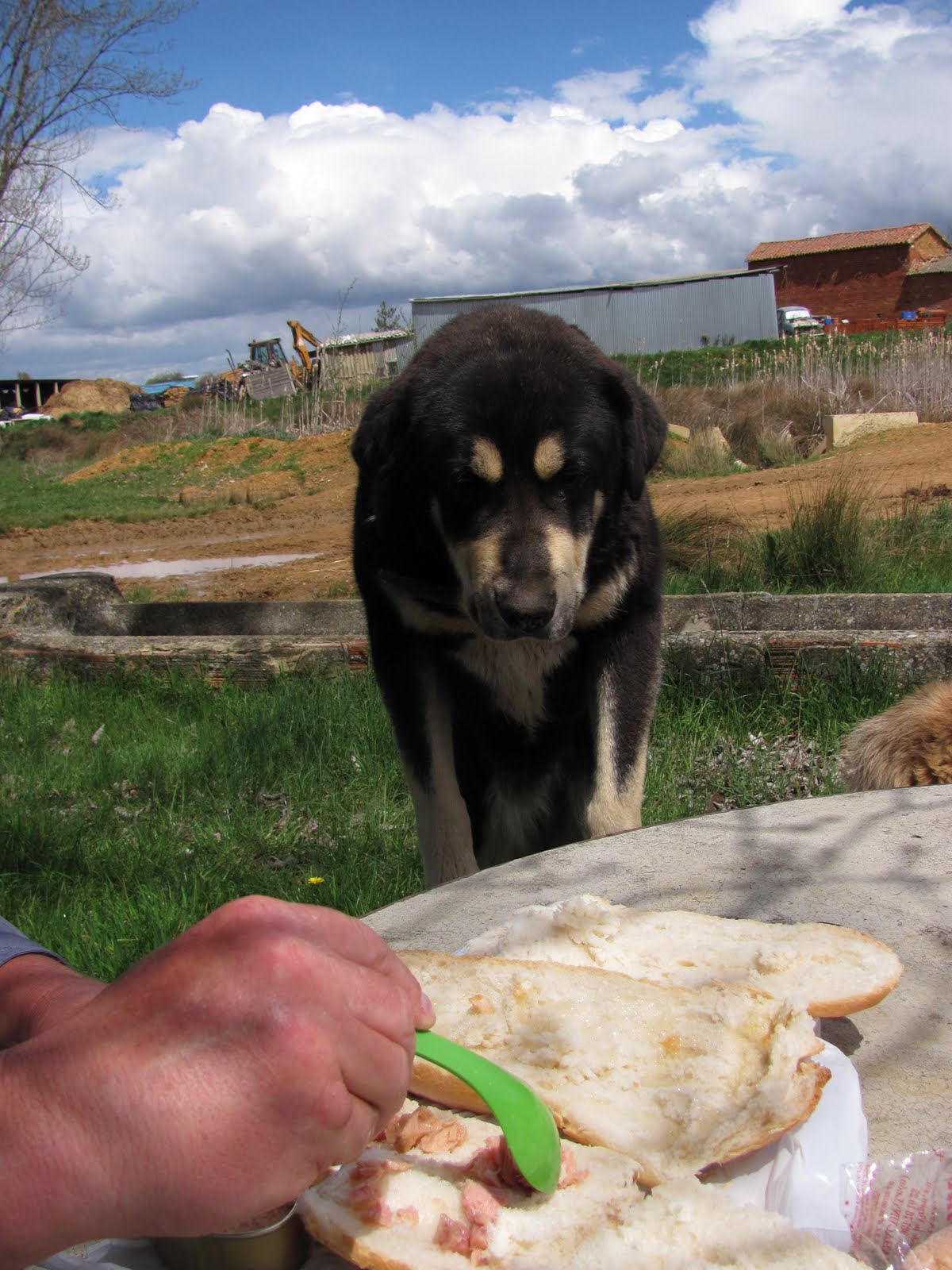
We walk a few more hours, before stopping to make a picnic lunch. For us, lunch is usually a baguette with tuna, or salmon, or Parma ham with cucumber or tomato, and an apple, or bananas. Sometimes a village dog will come to investigate what we are eating and ask us to share. We drink lots of water throughout the day. Refills are available from spouts in the villages’ main plazas.

By 3 in the afternoon, we are usually ready to stop for the day – our feet are killing us and I am ready to throw my pack into a ditch. But there isn't a church steeple in sight, so we must keep going. I pray that there is not a steep ascent, or any change in elevation at all, before we get there. It doesn’t matter if we walk 13 kilometers or 24. The last 4 kilometers are always murder.

Finally, we reach a village and follow the yellow arrows to an albergue or refugio (same thing). The villages often seem completely deserted. There are many For Sale signs. The recession has hit Spain hard.

Once inside the refugio, we present the Pilgrim Credentials that were issued to us on our first day in Pamplona. The hospitaliar puts a stamp inside our “passport”, and we pay the cost of accommodation, usually between 5-8 euros, or whatever you want to donate. Then, we are assigned 2 beds in a dormitory. If we are early (HA!), they might say, “Pick any bed.” Near a window, away from the ablutions is a good choice. Some people take naps, some shower, some write in journals, or read, or talk. ‘Wasn’t it pretty today?”, “Did you stop at the Templar church?"
Sometimes there is local entertainment. In one village, the hospitaliar suddenly exclaimed, “The cows are coming!” and we all went out to watch a nightly parade of cows walking through the main square with the locals. Scott was inspired. We tied red sashes (the rain covers for our packs) around our waists and "ran with the bulls". Only, they weren't bulls. They were matronly cows with milk-swollen udders.

At 7:30 or 8 pm, a “pilgrim meal” is served, usually at the one bar or restaurant in town, or sometimes at the albergue. We select from a first course of soup, or salad, or paella, a second course of stew, pork, fish, rabbit, or chicken, and a dessert. Every meal comes with water, bread, and a bottle or two of wine, all for between 8-10 euros. I love the pilgrim menu! We walk all day, have a hot shower, then someone cooks for us, and brings us all the wine we want. The only bad part is that we eat this big meal, and then it’s time to go to bed. Lights out is usually 10 pm. This is when the conversations with God begin in earnest. Dear God, can the mattress be long enough to stretch out in and un-lumpy enough for a good sleep? Dear God, I hope it doesn’t rain tomorrow. The best I’ve overheard are "Lord, bless and heal my feet" or the ever popular, "God, let my sleep be peaceful".

Mine always is, Please, God, help me convince the Spaniard sleeping in the next bunk that fresh air is a good thing. This is how the conversation goes each night between me and the person in the next bunk. I try my best to communicate in Spanish, which by now you know is pretty bad, to say the least.
I open the window.
Spaniard says, “No! During the night the air will cross my face!”
“Yes!” I say. “The time in this temperature is very good!”
Spaniard looks at me with mixture of pity and confusion and says once more, “No!”
I plead with my eyes and say, “Until sleep time, it is well that the window is open for business!” Spaniard rolls over.
The symphony of snoring begins.

Scott and Tris
On the Way of St. James
Camino Francais, Spain
Spain

The Handkerchief - On the Camino de Santiago


Two hundred and forty kilometers into our walk of The Camino, Scott came across a mauve handkerchief on the trail. It was a wet day on a muddy track, but the handkerchief wasn’t soiled, so we assumed the two girls from Prague walking 50 meters ahead of us must have dropped it. Scott looped it around his backpack belt and we increased our pace to catch up to the girls.
“Did you drop this?” Scott asked. One of the girls laughed. “I didn’t realize I dropped it. But you must keep it now! You see, I found this scarf on the trail five days ago and, as you did just now, I picked it up and assumed the Italian guy hiking ahead of me had dropped it. He said it was not his, but that he found it on the trail two days ago and had unsuccessfully tried to find the rightful owner. Someone said they had seen it on a Brazilian man. I have been looking for a Brazilian man ever since. Anyway, you must keep the scarf now.”

So Scott is the fourth person on The Camino (that we know of) to come across the Brazilian-Italian-Czechoslovakian handkerchief . He has it looped around his trekking pole strap and will carry it to Santiago - if he doesn’t drop it on the trail first.

Scott and Tris
On the Camino to Santiago, Spain


Thursday, April 22, 2010

Bon Camino, Madam! - On the Camino de Santiago


Correction: Not all the accommodation on the Camino (Albergues or Refugios) are spotlessly clean. I am now officially a flea-bitten Pilgrim.

Many of the Refugios on the Camino are in stone buildings, old drafty monasteries, or farmhouses. The floors are so cold that Scott uses them to chill a can of beer, or keep our breakfast yogurt cold and free from anything but the "healthy" bacteria we paid for.
To prevent Pilgrims from catching pneumonia at night, there is always a stack of heavy wool blankets in the dormitories. Only, fleas need a warm place to sleep at night too, and Spanish fleas seem to favor wool. My down sleeping bag is plenty warm, but one particularly cold night I decided to throw a blanket over my bag. I was toasty warm - and the fleas were well fed.

Usually our only option when sleeping in a refugio is a bunk in a 20, or 30, or 100 bed dormitory. It’s actually fun and part of the Peregrino (pilgrim) experience.
One rainy afternoon in a crowded dorm room, Tia from Finland, sat on a top bunk bed tending to her many blisters. A Frenchman across from her began offering blister care advice. He seemed to know everything there was to know about blisters. Then an Italian girl crossed the room while gesturing passionately to Tia's foot. "Sbagliato!" she said. "If you do as the Frenchman says, you will lose your foot!" Soon Tia was the center of an animated debate in Spanish, French, German, Finnish, Slovenian, Korean, Italian, and English on whether to puncture the blister, or leave it alone. I listened intently to the advice since I had a blister the size of a cherry tomato brewing on my own big toe.

Later, I learned that certain songs penetrate all borders when a Slovenian woman joined me at the bathroom sink and announced, “I just love The Macarena!” A Spanish woman at the next basin began singing the lyrics while we all danced in unison, me with a toothbrush in my mouth.

It’s always entertaining staying in what the Spanish call a dormitorio, but whenever it’s available we always ask for a matrimonio, the quaint term for a room with one bed, or un quarto con dos camas, solimente, a small room with only two beds. We’ve been lucky. One time, we stayed at a monastery in a small room with 3 beds and, because it was so late in the day when we arrived, we had the room to ourselves. In another village with a population of 80, we were initially shown a bunk bed in large dorm, as usual. I pleaded with the  hospitaliar (the name given to the owners or volunteers running the refugios), “Es possible, Senor, un quarto con dos camas solimente, or un matrimonio?”
“Ah. Come with me,” he said, and led us up three flights of stairs to the attic. Under a skylight were two single beds and one bunk bed. There was also an ab-buster exercise machine, a desk, a fold-a-bed, and forgotten toys. Obviously, it was a combination overflow accommodation for Pilgrims during the busy summer season, and storeroom for the owner. We loved it. "All for you. Todo por dos,” he said with a smile and a wink. As he watched us slowly remove our boots and coats he added gravely, "Feel free to use the ab-buster."

We did our laundry (a daily hand wash obligation when on the Camino –wear one, wash one) strung a clothesline under the skylight, and pushed the two beds together.

Something one should know ahead of time about a refugio is that there are no locks on the doors. It is not uncommon to see a sleep deprived Pilgrim, driven out of his bed by snoring bunk mates, walking the halls and opening random doors looking for a quieter room to sleep in. We knew there was a slight risk that someone would try to join us in our quiet little room at the top of stairs, but since we were three flights up, and I had positioned a big red umbrella, open, at the top of the stairs, I felt pretty confident that no one would wander in to the room in the middle of the night.

I can’t tell you exactly how many times the door opened during the night, but the last time the door opened was, let’s say, particularly bad timing. “Oh! Pardon!” a Frenchman exclaimed before retreating. The lights were out and I had quickly thrown a sleeping bag over Scott and me so I thought the man didn’t see anything more than the silhouettes of our laundry hanging on the line.

The next morning, as we chatted with other Peregrinos over breakfast of café con leche and croissants in the refugio dining room, a Frenchman announced, “Buen Camino!” (Good walk!) as everyone says to one another before they set off on the trail for the day. As he crossed the room his eyes settled on me with sudden recognition. He looked me right in the eye, winked and said, “Et, Bon Camino a vous, Madam!”


Scott and Tris
On the Camino Francais
Spain

Thursday, April 15, 2010

A Boat, Boots, Bedouins, and A Bridge - On the Camino de Santiago

A Boat:

On March 16th, 2010, I was busy loading my backpack (one pair boots, 2 pair socks, 2 pair hiking pants, 2 t-shirts, rain gear and, last but not least, ear plugs) for a 6-week trek in Spain when Scott said, “What if we travel to Spain by sea instead of by air?” By the 17th I was trying to fit cruise attire into my backpack. By the 20th, Brazilians (we boarded in Sao Paolo) were handing Scott their cameras and asking him to take their photo.
We didn’t manage to fit much cruise wear into our packs after all, so I think they mistook him for crew. (This has happened to us before). Scott played along, cheerfully arranging everyone and putting them in the best light. “Smile! Say queso!” he said, which wasn’t even right since the Portuguese don’t say, “cheese” before taking a photo. If they did it would sound more like “kejzo” anyway. But queso or kejzo, it didn’t matter. Both end in an “O", so a few Brazilians who mistook Scott for crew have photos of themselves looking like they've just been goosed.

We occupied our days at sea by finding creative ways to make hiking gear passable on “formal” nights (impossible), and by reading, playing trivia, and talking to nice people, especially those from Holland and America. Most afternoons found Scott in the library, where he learned to play Bridge from a patient teacher who just happened to be the doppelganger for my wonderful brother Mike. That was nice...

Boots:

My hiking boots disintegrated on the flight over from San Jose. I don’t know how or why. At first I took it as a sign from God. After all, what idiot would commence a 500-mile trek without training for it? Yours truly and her one true love, that’s who! Our training consisted of walking around the ship - four times around the deck was a whole mile.
After one such rotation I noticed that my boot was baring its sole all over the promenade deck - insulation was flying everywhere. Soon, the entire boot bottom was flopping around after me like a spatula stuck to my foot. I needed appropriate shoes for the hike in Spain, but our favorite outdoor store, REI, was an ocean away. But I was in luck! The island of Tenerife, off the coast of Africa, is a duty-free shoppers paradise  that specializes in electronics. They also sell footwear such as Nike, Puma and Solomon.

At the first shoe store, the saleswoman said with disbelief, “Size 9 and a half! Are you kidding me?” Then, she announced it over the P.A. system. The other customers in the store pointed at me and stared, waiting to see what would happen next. I know they were thinking, ‘Big foot! It’s not a myth!’

The shop clerk gave me a look of pity as I left, shoeless: How ever did you get this nice man to marry you with feet the size of tennis rackets? her eyes said.

After several more false starts and sniggers by wide-eyed shoppers and clerks, I was able to find a pair of Solomon hiking boots that fit perfectly. So what if I had to buy them in the men’s department? They have served me perfectly well so far.

We began the hike in Pamplona, home of the running of the bulls and occasional hangout for the late Ernest Hemingway. In Pamplona you can find signs such as, ‘Hemingway slept here’, ‘Hemingway wrote here’, ‘Hemingway drank here’, and random shops simply called 'The Hemingway'. We didn’t stay at the Hotel Hemingway near the bullring because it was 200 euros per night, but as we stood in the lobby soaking up the aura of the notorious adventurer, a hotel guest noted our hiking apparel and said, “You must be Peregrinos. You should stay at the Refugio!” He walked us there, pointing out the places where Hemingway had a cigar and took a lover.

For more than 900 years Peregrino has been the term for anyone hiking The Camino de Santiago.  Refugios, or Albergues, were where they slept.
In Pamplona, for 6 euros each, we were assigned a bunk in a 100-bed dormitory that was housed in an ancient monastery. We were numbers 92 and 93 to sign in.
Most refugios on the Camino have at least 30 beds in one room. “Sounds smelly!” you might be thinking, and you would be right. Hundreds of years ago, a monk or priest would walk through the Refugio swinging a smoking incense ball to dull the odiferous funk of the pilgrims as they slept. Modern day Refugios have hot showers, laundry machines, Internet, and kitchens. Still, that first night in Pamplona, I thought a few passes with an incense ball wouldn’t hurt. Two hundred sweaty boots smell like a wet cow. No worse than that - like a wet cow with bad breath that snores with its mouth open.


It’s not that bad. I brought lots of earplugs with me, the refugios are spotless, and a slight smear of Vicks under the nose works wonders. If it weren’t for all the Germans who get up at 5 a.m. to use up all the hot water and race to the next Refugio for the best bunk (the German half of me really wants to do that too), the refugio experience would be great.
So far, all the refugios are co-ed. Even the dorms and the bathrooms aren’t divided by sex. It’s like living in a house with a hundred brothers and sisters from all over the world. We’ve met Estonisan, Dutch, German, Irish, English, Canadian, and lots of Spanish peregrinos. On rare occasions we get a double room to ourselves, and that is muy bien. So far, we haven’t met any other Americans but we probably will meet one or two over the next 40+ days of the hike.

One is supposed to be on a spiritual or cultural quest to hike The Camino. If we see it as a spiritual quest, and make it to Santiago, where the bones of St. James rest in peace, we will be awarded an indulgence. An actual indulgence! That means if I complete the Way of St. James, as the Camino is called, I will earn an indulgence and all my sins will be instantaneously wiped clean. Poof! Permanent record erased. Then, if I were to get hit by a car or something before I have a chance to sin again, I would go straight to Heaven. The chances that I wouldn't sin again shortly after leaving the compostela office by, say, taking the Lord's name in vain,"Gosh darn! That is one beautiful Cathedral!" (only it wouldn't be "gosh"), or coveting chocolate or beer or woman's boots is pretty remote. The "express to Heaven" reward was more significant before the Pope did away with purgatory anyway. But still, I will be walking a little lighter after I gain the indulgence, at least for a few moments.
Strange to say if you know me, but I do feel spiritual while walking the Camino. At least that's how I interpret the vibe. I feel just so darn happy all the time. I have long thought nature is my religion and I feel closest to my Maker when I am out in it.
Scott says his intention is a cultural quest, which I don’t mind one bit, because he has been giving me history lessons everyday. Whether it be details about an old Roman road we are walking on, or tidbits regarding Spanish or Portuguese explorers, it is always interesting and takes my mind off my aches and pains.

“Keep an open mind,” I suggested. “After 6 weeks on the trail, you might find it has somehow become a spiritual quest.” To which he replied wincing, “Very likely since my feet might die and go to heaven before I get there.”
I hope that doesn’t happen. But this is only day 4 of our hike, and he is already walking like Amos McCoy. I resemble Grandma Moses - in mens boots. I don't think I needed to clarify that. I think Grandma Moses always wore mens boots, didn't she?

Every day, we trod up and down hills, through vineyards, olive groves, and newly planted wheat fields so green the wheat looks like a jade river swirling down hills and around the vineyards. We walk from village to village, over narrow, or muddy, or rocky footpaths just the way pilgrims did 900 years ago - except we are powered more by café con leche and chocolate croissants, than by gruel. The villages are so charming, and the churches along the way so magnificent, that they distract us from thinking about our sore feet or backs, or calves, or thighs, or knees, or shoulders-- at least for a little while. We walk about 12-15 miles per day, which takes us 6 to 8 hours depending on the terrain. But our packs are way too heavy because we have stuff in them that we don’t need in Spain, but which we do need for Africa, which leads me to Bedouins.

Bedouins:

Mid-May will find us in Cairo, where we will join an overland truck for a ten week journey up the Nile that will take us through Egypt, Sudan, Ethiopia and Kenya.

In August, we will transit to Zambia to help build a bridge.

Bridge: A footbridge, that is, in Zambia. We will work with a non-profit called Bridges to Prosperity. Learn more about how we became connected with this organization at: www.firstgiving.com/teresaokane

We’ll be gone Five months, Bridge (San Francisco) to bridge.

We love hearing from you!
Hasta Luego! Scott and Tris

Torres del Rio, where Hemingway, as far as I know, didn’t sleep.
The Way of St James,
Spain

Haiku (sort of) for the day:
Behind the hay
I peed
The hills were green